Mount Kailash Trek 2026 –, Latest Flights to Mount Kailash & Travel Guide
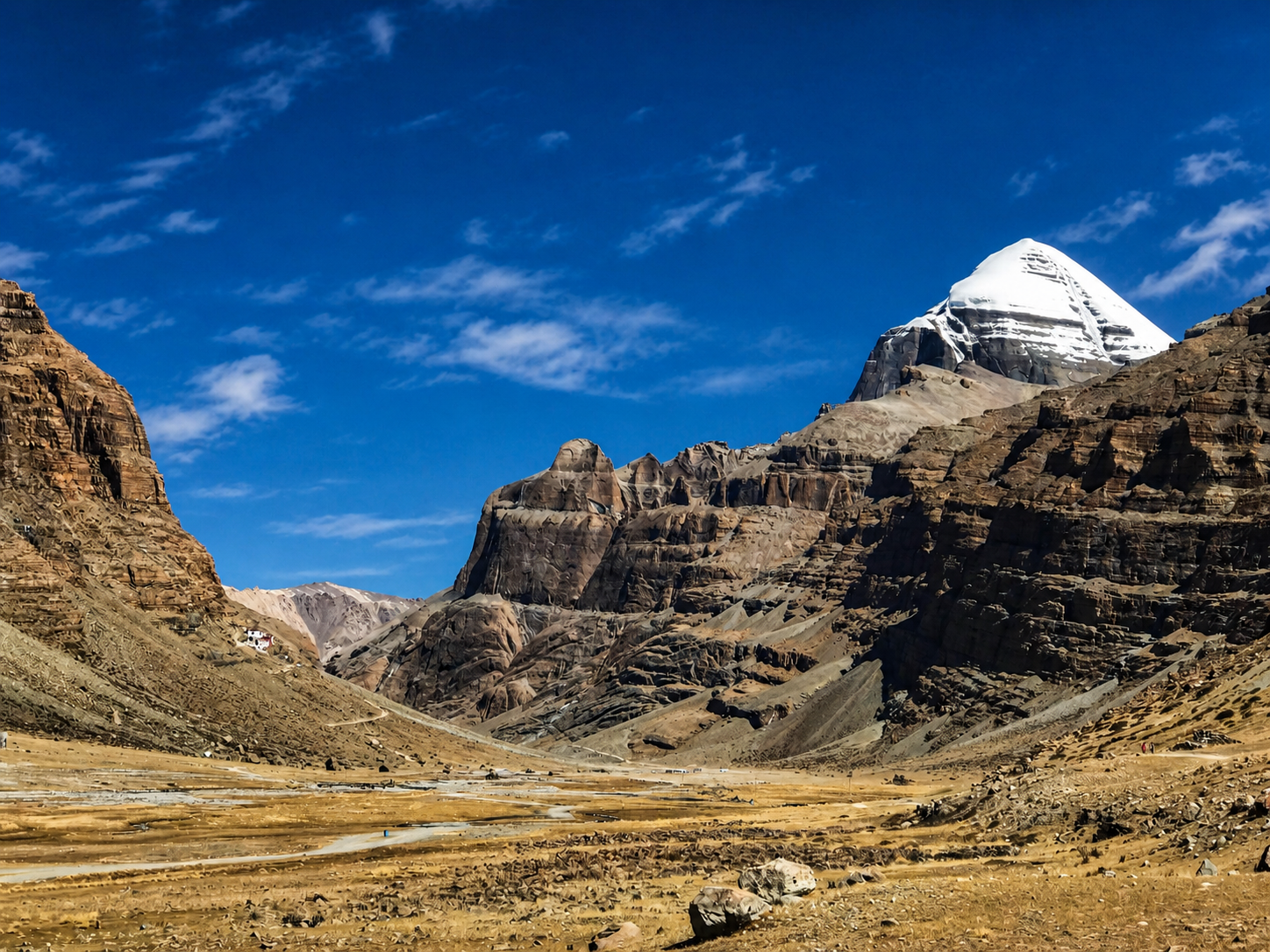
There’s a mountain in Western Tibet that doesn’t need superlatives. Mount Kailash Trek 2026 — The mistery Mount Meru, at 6,638 metres, sacred to four of the world’s great religions — simply stands. Hindus know it as the abode of Lord Shiva. Tibetan Buddhists circumambulate it as the most meritorious pilgrimage on earth. Jains and Bön practitioners have made this journey for millennia. And increasingly, international travellers are arriving not to conquer the summit (which remains closed to climbing out of respect for its sanctity), but to walk in the footsteps of millions of pilgrims before them.
We’ve been organising Mount Kailash tours from Lhasa since the early days of modern Tibet travel, and we’ll tell you plainly: 2026 is shaping up to be one of the best years in recent memory to make this journey. New air routes have dramatically shortened travel times, permit processes are running more smoothly, and the trail infrastructure has seen meaningful improvements. Here’s everything you need to know to plan it right.
How to Reach Mount Kailash in 2026
Getting to Mount Kailash has historically been one of the journey’s great challenges. The mountain sits in the Ngari prefecture of Western Tibet — a vast, sparsely populated plateau at over 4,500 metres above sea level. For decades, the only options were an overland drive from Lhasa (roughly 1,600 km) or a combination of flights and roads. That calculus has recently shifted.
Flights from Lhasa to Ali Kunsha Airport (NGQ)
The most practical gateway for most international travellers is Lhasa Gonggar Airport, from where Tibet Airlines now operates daily direct flights to Ali Kunsha Airport (NGQ) in Ngari prefecture. Two separate routes cover this corridor:
- TV9943/TV9944 — Daily service, operated on Airbus A319neo
- TV9723/TV9724 — Additional daily frequency, operated on Airbus A319/A319neo
The flight takes approximately two hours and drops you in Ngari, from where the drive to Darchen (the base town for the Kailash Kora) is roughly four to five hours along well-paved roads. Round-trip fares on the Lhasa–Ngari route typically start around CNY 2,400–3,200 in economy class including taxes, depending on how early you book. We advise booking at least six to eight weeks in advance during peak season.
This combination — fly into Lhasa, spend several days acclimatising and sightseeing, then fly to Ngari — is currently the most efficient and comfortable itinerary for most of our guests. It is a great and easy way to complete your Mount Kailash Trek in 2026 by flights from Lhasa to Ali Kunsha or from Lhasa to Purang county.
New Direct Flights from Ali Kunsha to Chengdu
The genuinely game-changing news for 2026 is the new direct air link between Chengdu Tianfu International Airport and Ali Kunsha Airport (NGQ). Operated by Tibet Airlines under the flight numbers TV9747/TV9748 on Wednesdays and Fridays, this A319neo service opens up a routing that simply didn’t exist before.
Previously, travellers coming from Chengdu — one of China’s main hubs and a common connection point for international visitors — had to transit through Lhasa. Now, you can fly direct into Ngari and begin your Kailash journey faster. Round-trip fares on the Chengdu–Ngari route are generally in the range of CNY 3,600–4,800 economy, including taxes. Given the time saved, many of our repeat visitors are already building this into their 2026 itineraries.
A word of practical caution: because Ali Kunsha Airport sits above 4,500 metres, we still recommend arriving in Lhasa first for at least three to four days of acclimatisation before flying onwards to Ngari — even on the direct Chengdu route. Altitude sickness is not something to gamble with, and the trek itself begins the day after you reach Darchen.
Flights from Lhasa to Purang (Ali Pulan Airport, APJ)
For travellers planning a combined Kailash and Lake Manasarovar itinerary who want to exit via the Nepal border at Hilsa, or for those approaching from the south, Tibet Airlines also operates a daily service between Lhasa and Purang on TV9961/TV9962, using the Airbus A319neo. Purang (historically known as Taklakot) is around 100 km southwest of Mount Kailash and is an excellent secondary access point. Round-trip fares on this route run approximately CNY 2,600–3,400 economy including taxes.
Planning Your Mount Kailash Trek
Trek Routes and Duration
The heart of any Mount Kailash tour is the Kora — the ritual circumambulation of the mountain. The full circuit covers approximately 52 kilometres, passing through some of the most dramatic high-altitude landscape on the planet.
The Kora begins and ends at Darchen (4,560m). Most trekkers complete it over three days, though physically fit and well-acclimatised individuals occasionally manage two days. Here’s how the route typically unfolds:
Day 1: Darchen to Dirapuk Monastery (4,860m) — The first day follows the northern flank of Kailash, offering the iconic north face views that have appeared in every travel piece ever written about this mountain. What those pieces rarely mention is how the light plays differently depending on the hour — gold at dawn, silver at midday, shadow-purple by late afternoon. The trail itself is manageable, roughly 22 km, and Dirapuk Monastery offers simple but welcoming guesthouse accommodation with views most people can barely believe are real.
Day 2: Dirapuk to Zuthulpuk via Dolma La Pass (5,636m) — This is the crux. Dolma La Pass is the high point of the Kora and, for many pilgrims, the spiritual heart of the entire journey. The approach is steep and, at altitude, genuinely demanding. Tibetan pilgrims prostrate the entire route; most international trekkers are simply glad to walk it upright. At the pass itself, you’ll find strings of prayer flags and, if your timing is right, the extraordinary experience of hundreds of pilgrims from across Asia sharing the same sacred space in silence and reverence. The descent to Zuthulpuk (4,790m), where you spend the second night, is long but gentler on the legs.
Day 3: Zuthulpuk back to Darchen — A relatively straightforward 14 km return leg along the valley floor, during which the mountain seems to recede slowly, as if releasing you.
One route note our guides always emphasise: the Kora is walked clockwise by Buddhists and Hindus. Bön practitioners walk it counter-clockwise. Unless you follow the Bön tradition, walk clockwise — it matters to the pilgrims you’ll share the path with.
Best Season to Visit
The trekking window runs roughly May through October, with the sweet spot being late May through early September. Here’s how the season breaks down in practical terms:
- May–June: Clear skies, manageable temperatures, and far fewer crowds than July. Snowfields on Dolma La make for dramatic photography but can slow the ascent.
- July–August: Peak pilgrimage season, coinciding with the Saga Dawa Festival (full moon of the fourth Tibetan month, usually May/June — check the 2026 calendar carefully). This is when the mountain is most alive with pilgrims. Also the wettest period.
- September–October: Our personal favourite. Post-monsoon skies are often the clearest of the year, temperatures are still workable, and the pilgrim crowds have thinned noticeably.
We strongly advise against planning your Kora for November through April. Winter conditions on Dolma La are dangerous, and road access to Darchen can be cut off entirely.
Permits and Travel Requirements
Foreign visitors to Tibet require several overlapping permits, and the Mount Kailash region specifically requires additional documentation beyond the standard Tibet Travel Permit. As of 2026, the essential permits are:
- Chinese Visa (with Tibet Travel Permit letter before application in some consulates)
- Tibet Travel Permit (TTP) — the foundational permit, arranged through a registered Tibetan travel agency
- Aliens’ Travel Permit — for Ngari prefecture specifically
- Military Area Entry Permit — required for areas near the border
We handle all of these for our guests through Tibet Shambhala Adventure. Independent travel in Tibet is not permitted for foreign nationals; all tours must be arranged through a licensed operator. If you’re reading this and wondering whether you can “just show up” — you cannot, and attempting to do so will result in being turned back at checkpoints. Book through a reputable operator, let them handle the paperwork, and focus your energy on acclimatising.
Experiencing Local Tibetan Culture
Mount Kailash is not simply a trekking destination. It is one of the world’s great pilgrimage sites, and the cultural texture around the mountain is inseparable from the landscape itself.
Nomadic Camps and Local Villages
Between Darchen and the surrounding valleys, you’ll encounter Tibetan nomads — drokpa in Tibetan — whose families have grazed yaks on these high pastures for generations. Depending on the season, you may pass their black yak-wool tents, watch herders move their animals to higher ground, or share a bowl of butter tea offered with the quiet generosity that characterises Tibetan hospitality. These encounters are not manufactured for tourism; they happen because the land is still lived in by people who call it home.
The village of Barka, near Darchen, is worth an afternoon’s exploration. Small, unhurried, and largely untouched by the tourist infrastructure of eastern Tibet — it gives a more honest glimpse of daily life in Ngari than you’ll find elsewhere on a Kailash tour.
Monasteries and Sacred Sites
Dirapuk Monastery, perched above the valley on the north face route, is the most visited monastery on the Kora. The resident monks are accustomed to pilgrims but not indifferent to them. Spend time here rather than rushing through.
Zuthulpuk Monastery, at the southern end of the circuit, is associated with the great Tibetan saint Milarepa, who is said to have meditated in a cave here. The monastery is smaller and quieter than Dirapuk, and the atmosphere in the early morning — before the day’s trekkers arrive — is something we’ve struggled to describe adequately in fifteen years of bringing people here.
Lake Manasarovar, roughly 30 km east of Darchen, is almost always included in a Kailash tour itinerary and, for many travellers, ends up being the unexpected emotional high point of the journey. At 4,590 metres and stretching 88 km in circumference, it is one of the highest freshwater lakes in the world. Its colour — a blue that shifts between turquoise, indigo, and silver depending on the weather — is not something photographs fully capture.
Practical Tips and Recommendations
Accommodation Options
Darchen has developed meaningfully in recent years. You’ll find comfortable guesthouses with en-suite rooms, reliable heating (essential at this altitude), and decent Tibetan and Chinese food. On the Kora itself, Dirapuk and Zuthulpuk both have guesthouses attached to their monasteries — simple, clean, and perfectly adequate for a single night.
For pre- and post-trek nights in Ngari, the town of Ali (Shiquanhe) has a small selection of better hotels, including a few that qualify as genuinely comfortable. We typically route our guests through Ali for their first Ngari night to allow final acclimatisation before driving to Darchen.
Packing Essentials and Safety Tips
Packing for Mount Kailash requires thinking about three distinct environments: the high plateau (cold, dry, windy), the Kora itself (aerobically demanding, potentially snowy on Dolma La), and the warmer, dustier drive corridors.
Non-negotiables include:
- Layering system with a serious down jacket (nights at Darchen regularly dip below freezing, even in summer)
- Trekking poles — Dolma La descent is hard on knees
- High-SPF sunscreen and glacier glasses (UV at this altitude is brutal)
- Personal altitude medication — Diamox (acetazolamide) is commonly used; discuss with your doctor before departure
- Water purification tablets or a reliable filter
- Cash in Chinese yuan — cards are largely not accepted in the Ngari region
On the topic of altitude: do not rush acclimatisation. The single most common reason guests have a difficult time at Kailash is arriving in Ngari too quickly after leaving sea level. Build at least three to four days in Lhasa (3,650m) into your itinerary before flying to Ngari (4,500m), and ideally a night in Ali before driving to Darchen.
Ready to Plan Your 2026 Mount Kailash Trek?
We’ve been guiding travellers to Mount Kailash through Tibet Shambhala Adventure long enough to know that this journey changes people. Not in the vague, marketing-copy sense — but in the specific, irreversible way that only truly remote and sacred places can. The mountain has that quality.
Our 2026 tour dates are filling, particularly around the
window and the September shoulder season. All itineraries include full permit handling, acclimatisation planning, and the kind of ground-level expertise that only comes from having walked this route ourselves, repeatedly, across many seasons.
If you’re ready to start planning — or just have questions about whether this journey is right for you — reach out to us directly. We’ll give you an honest answer, tailored itinerary options, and all the practical detail you need to travel safely and meaningfully to one of the world’s most extraordinary places.
Contact Tibet Shambhala Adventure to begin planning your Mount Kailash Tour 2026.