When Is the Best Time to Visit Everest Base Camp in Tibet in 2026?
Your Accurate, Season-by-Season Guide to Qomolangma’s North Face
Some mountains exist to be seen in photographs. Qomolangma — the name Tibetans have always given to what the world calls Mount Everest — is a mountain you need to stand near to understand. When that north face fills your field of vision at dawn from the Rongbuk Valley floor, something shifts in your sense of scale that no image on a screen ever quite prepares you for. If you’re reading this in 2026 and asking yourself when to go, you’re already asking the right question — because the best time to visit Everest Base Camp in Tibet depends on far more variables than most travel content acknowledges.
The encouraging reality for travelers planning a Tibet trip this year is that the Everest region is considerably more accessible across the calendar than conventional wisdom suggests. Roads have been upgraded and fully paved. Climate patterns on the Tibetan Plateau have shifted in ways that make formerly “bad” months genuinely suitable. The tourism infrastructure supporting Tibet travel has matured substantially. Understanding what each season actually delivers — rather than what outdated guides claim — is the foundation of a well-planned Tibet tour.
This guide is written with one purpose: to give you accurate, current, honest information so you can make the best decision for your specific trip. Whether you’re organizing a dedicated Tibet trekking expedition, a photography-focused itinerary, a first-time family Tibet tour, or simply the journey of a lifetime to travel to Tibet and see the world’s highest peak — every season is covered in full below.
Two Everest Base Camps: Understanding Which One This Guide Covers
Before any seasonal advice makes sense, one foundational point needs to be clear — and most travel content handles it poorly.
The Everest Base Camp most people picture from popular trekking content is the Nepal-side camp, accessed through the Khumbu Valley via Lukla. That is a separate journey entirely, on the other side of the mountain. This guide covers the Tibetan north-face approach — the Rongbuk Valley route, within the Qomolangma National Nature Reserve, accessible by road via the Friendship Highway from Lhasa.
The experience on the Tibetan side is fundamentally different. You arrive by vehicle — not on foot after days of trekking. The landscape of the high plateau surrounds you before the mountain appears. The north face reveals itself gradually as you approach through the valley, and what you see when it does is an unobstructed, vast, nearly vertical wall of rock and ice that the Nepal approach — for all its drama — simply does not show you.
All foreign visitors to the Tibetan side require three permits: the Tibet Travel Permit, the Alien’s Travel Permit, and the Military Area Permit. These cannot be obtained independently — every legitimate Tibet tour must be organized through a licensed Tibet tour operator registered with the Tibet Tourism Bureau. This isn’t a technicality; it shapes your entire planning timeline and directly determines which months are feasible for your visit.
One more critical infrastructure point: all roads on the Tibetan route to Everest Base Camp — including the Friendship Highway and the approach roads into the Rongbuk Valley — are fully paved and professionally maintained year-round. Claims about seasonal road closures, washouts, or impassable sections found in older travel content no longer reflect the reality of Tibet travel on this route.
The Base Camp Access Policy: The Most Misunderstood Rule in Tibet Travel
This is the section most Tibet travel guides either skip or get wrong. Getting it right fundamentally changes how you interpret everything else in this article.
On the Tibetan side, there are two distinct zones. The first is the original 5,200-meter Everest Base Camp — the historically famous location where professional mountaineering expeditions established their camps. Since 2017, this area has been permanently and completely closed to all ordinary tourists. The closure exists for ecological and environmental conservation reasons and is managed by the Qomolangma National Nature Reserve authorities. It is not seasonal. It is not weather-dependent. No tourist permit grants access to this zone.
The only people permitted inside the old 5,200m base camp are certified professional mountaineering teams holding official expedition permits from Chinese mountaineering authorities. Their primary operating window is April through early June — the spring climbing season. Ordinary travelers, regardless of fitness, experience, or the quality of their Tibet travel permits, cannot enter this zone.
📍 Where Tourists Visit: The designated tourist viewing area sits near Rongbuk Monastery at approximately 5,000 meters above sea level. This area provides clear, direct, unobstructed views of Everest’s full north face — and for the overwhelming majority of visitors, the experience here is everything they came for. Rongbuk Monastery itself, the highest monastery in the world, anchors the tourist zone and is the primary orientation point for all Tibet tours visiting Everest.
This is the viewing area this guide refers to throughout. When you read “Everest Base Camp” in the context of Tibet travel planning for 2026, understand that this means the Rongbuk tourist viewing area — not the old closed camp above it.
Season-by-Season Guide: Finding Your Best Time to Visit Everest Base Camp in Tibet
Choosing the best time to visit Everest Base Camp in Tibet means evaluating what each season genuinely delivers — not what general Himalayan travel assumptions suggest. The Tibetan north-face location has specific climate characteristics that separate it from what you’d experience on the Nepal side or at lower Tibetan elevations. Here is what each season actually looks like.
Spring: April to Early June — Exceptional Clarity, Expedition Energy
Spring is the season that defines the Everest Base Camp experience for most travelers who visit on a Tibet tour. The reasons are real and the enthusiasm is justified — with one important caveat that you need to factor into your planning.
As winter’s hold on the Tibetan Plateau releases through March and into April, the atmosphere achieves a quality of stillness and clarity that high-altitude photographers travel specifically to capture. Morning light in April strikes the north face of Everest at an angle that reveals the mountain’s full architectural drama — every ridge, buttress, and hanging glacier defined against a sky of profound blue. Daytime temperatures at the Rongbuk viewing area range from -4°C to 10°C (25°F to 50°F), cold in the mornings and genuinely comfortable in direct afternoon sun.
Spring is also Everest’s primary professional climbing season. Expedition teams from mountaineering programs worldwide converge on the Rongbuk Valley from April through early June, creating an atmosphere entirely unlike any other season. Even from the tourist viewing area, watching a fully equipped expedition prepare for the upper mountain against that backdrop produces a quality of awe that no photograph adequately conveys.
⚠️ Spring Planning Note: The old 5,200m camp is permanently closed to tourists year-round — but spring is when mountaineering teams are most active there. Your Tibet tour will focus on the Rongbuk viewing area, which delivers spectacular, unrestricted Everest views. Confirm your specific itinerary details with your licensed Tibet tour operator before departure.
Tibet tour pricing reaches its annual peak in April and May. Accommodation near Rongbuk books out months in advance during spring. If this is your preferred window for Best Time to Visit Everest Base Camp, work with your Tibet tour operator to secure permits and reservations a minimum of four to six months ahead. Late May and early June offer equally outstanding conditions with marginally reduced competition for availability.
Summer: June, July & August — Far Better Than Its Reputation Suggests
Here is where accurate 2026 travel information most sharply diverges from what many older Tibet travel guides still say. The summer months at Everest Base Camp have been broadly misrepresented in travel writing based on assumptions that no longer hold true — and travelers who avoid this period based on those assumptions are missing a genuinely rewarding window.
The Everest region on the Tibetan north side has been measurably affected by global climate change over the past decade. The traditional monsoon patterns that historically created persistent cloud cover and problematic precipitation have shifted dramatically. In July and August 2026, rainfall in the Rongbuk Valley is minimal. When rain does occur, it falls almost exclusively at night. Daytime conditions throughout summer are consistently sunny, with clear skies and excellent views of the mountain.
This is not a minor seasonal nuance. The heavy summer rainfall and persistent cloud cover that correctly earn monsoon warnings in Nepal-side trekking guides simply do not apply to the Tibetan north-face approach at this elevation and geographic position. Travelers who arrive at Everest Base Camp in July expecting monsoon conditions are regularly surprised — and relieved — by what they actually find.
Summer brings the Tibetan Plateau to its most colorful state. High-altitude wildflowers bloom across the meadows of the Rongbuk Valley in July and August, adding a richness of foreground color to Everest landscape photography that no other season provides. The mountain itself is fully visible on most mornings. Crowd levels are lower than spring. Tibet tour costs moderate from their spring peak. For travelers whose schedules align with summer, this is a far more suitable choice for a Tibet trip than its reputation implies.
June deserves special mention. Post-expedition quiet, outstanding weather that often rivals April and May in clarity, and no access restrictions make June one of the most undervalued months on the entire Tibet travel calendar. Experienced Tibet trekking guides increasingly highlight June as a hidden peak season.
Autumn: Mid-September to Late October — The Undisputed Best Season for Most Travelers
If you are asking what is the single best time to visit Everest Base Camp in Tibet and you have flexibility in your dates, the answer for most travelers is mid-September through late October. Autumn delivers the most complete combination of conditions across every variable that determines the quality of a Tibet tour experience.
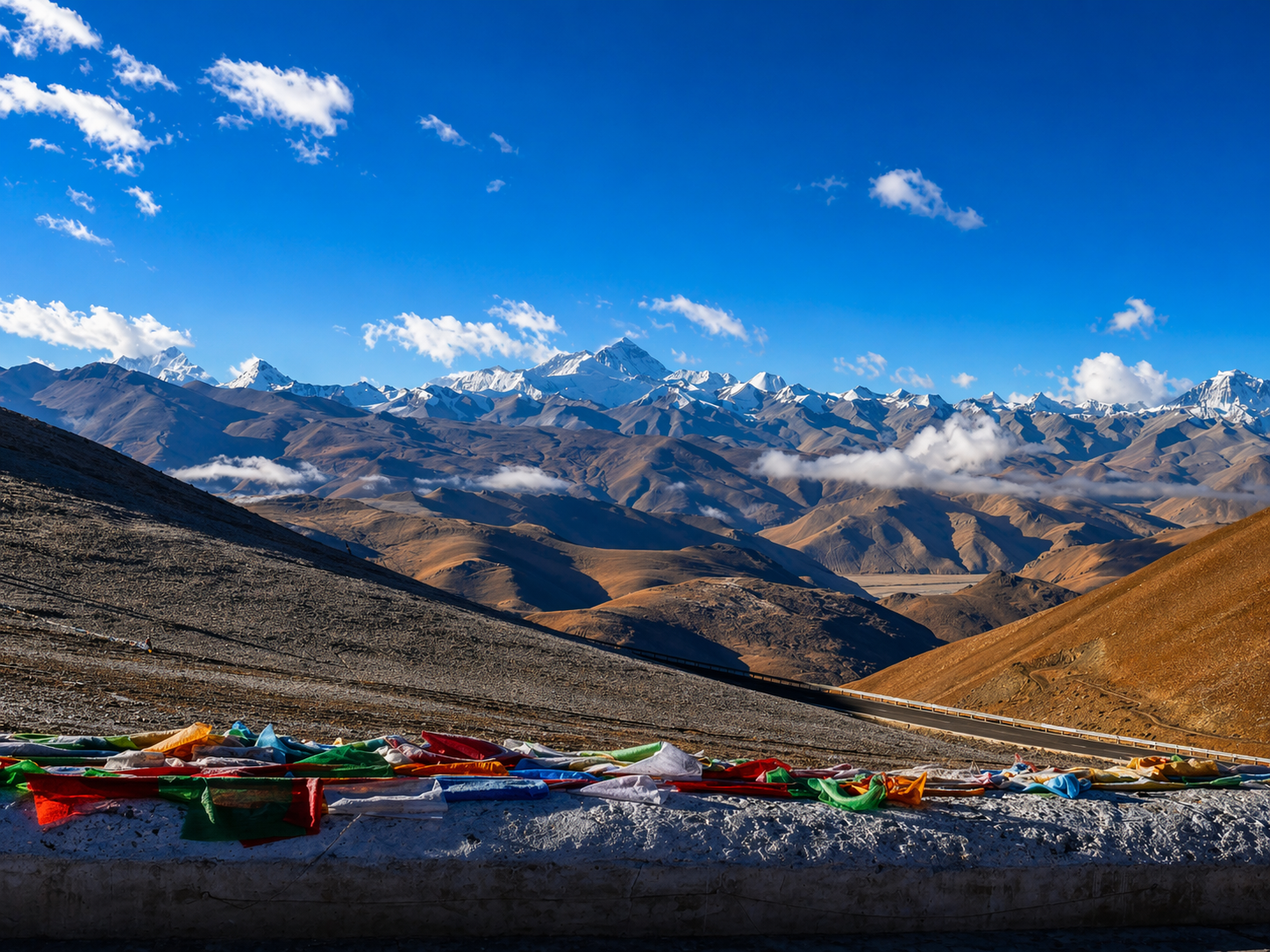
The weeks immediately following summer bring an atmospheric transformation to the high plateau that photographers and expedition teams describe consistently year after year. The air achieves an almost implausible clarity. The sky deepens to a blue that seems more saturated than ordinary sky has any right to be. Long-distance visibility reaches its annual maximum. Everest’s north face in the morning light of October is — by broad consensus among those who have experienced it — the single finest mountain view available to ordinary travelers anywhere on Earth.
September daytime temperatures at the Rongbuk viewing area settle between 2°C and 12°C (36°F to 54°F) — the most physically comfortable range for extended outdoor time of any season. October temperatures begin dropping, with days typically from -2°C to 8°C (28°F to 46°F), requiring proper layering but fully manageable for any reasonably prepared traveler. Nights at this elevation in October require serious insulation, which is why most Tibet tours arrange accommodation in the Rongbuk Monastery guesthouses during this season rather than camping.
Autumn carries no mountaineering-related access complications. All designated viewing areas are fully open. Guesthouses near Rongbuk operate at full capacity. The Tibet trekking approach roads are in their best condition of the year. Every logistical element of a Tibet tour to Everest Base Camp performs at its most reliable and complete during autumn.
For first-time travelers to Tibet, for families, for photographers who can only make this trip once, and for anyone who wants the highest possible probability of a perfect Everest experience — autumn is the recommendation with the least qualification attached.
Winter: November to March — Genuinely Viable, Uniquely Rewarding
Winter at Everest Base Camp carries a reputation for inhospitable conditions that the actual experience of well-prepared travelers does not entirely support. For the right traveler, winter offers a Tibet trip of unusual depth, extraordinary solitude, and compelling economic value.
An important clarification first: Tibet in winter is not what most people from temperate climates imagine. Lhasa and the central Tibetan Plateau enjoy winter days characterized by strong sunshine and dry, crisp air. Daytime temperatures in Lhasa during December and January are considerably warmer than in Beijing, Shanghai, Chengdu, and most cities across northern Europe and North America during the same period. The high-altitude sunshine creates a warmth that photographs rarely convey. At the Rongbuk viewing area itself — 5,000 meters above sea level — conditions are more demanding, but the day-trip approach (detailed below) makes the experience very manageable.
The guesthouses immediately adjacent to Rongbuk Monastery close from mid-November through late March. This is the most common reason travelers assume winter visits are impossible — and it is a misconception. Tashi Zong and New Tingri, located 60 to 90 minutes from the Rongbuk area, offer warm, comfortable hotels and traditional Tibetan homestays that remain fully open throughout winter. The standard approach for a winter Tibet tour to Everest is to base yourself in one of these towns, make an early morning drive to the viewing area for the extraordinary dawn light on the mountain, spend the morning at Everest, and return to town accommodation by afternoon.
November and December deliver Everest viewing conditions that experienced high-altitude photographers rank among the finest of the year. The post-autumn air at elevation in winter is exceptionally clear — often clearer than spring by measurable standards. The mountain stands in full, unambiguous definition against a winter-blue sky. Crowds are essentially nonexistent. The solitude of the Rongbuk Valley in December — prayer flags against white peaks, the ancient monastery walls, the silence — is a quality of experience that peak-season visitors never encounter.
Tibet tour costs in winter are the lowest of any season across the board — accommodation, ground transport, and package tour pricing all reflect the reduced demand. For budget-conscious travelers, this represents an exceptional opportunity to experience one of the world’s great destinations at a fraction of peak-season cost without meaningfully compromising the quality of the Everest experience itself.
❄️ Winter Verdict: November and December are excellent months to visit Everest Base Camp in Tibet. Stay in Tashi Zong or New Tingri, drive to the Rongbuk viewing area for the morning, and return to town by afternoon. Outstanding views, minimal crowds, lowest travel costs of the year — and a Tibet trip experience unlike anything the peak seasons offer.
Month-by-Month Everest Viewing Reference for 2026
Use this reference when deciding the best time for your Everest Base Camp visit in 2026. Ratings reflect viewing clarity and overall travel suitability from the Rongbuk tourist area.
March ★★★★☆ — Spring clarity returns. Pre-season quiet. Roads fully open. Strong shoulder season choice for Tibet travel.
April ★★★★★ — Peak spring clarity. Expedition season builds. Outstanding photography conditions. Book early.
May ★★★★★ — Prime spring window. Expedition atmosphere at full energy. Best mountain views of spring. Premium pricing.
June ★★★★★ — Underrated gem. Post-expedition calm, excellent weather, no restrictions. Highly recommended for Tibet tours.
July ★★★★☆ — Daytime sunny and clear. Night rainfall only. Vivid plateau wildflowers. No barriers to visiting.
August ★★★★☆ — Similar to July. Clear daytime skies, minimal crowds, comfortable atmosphere. Good Tibet trip value.
September ★★★★★ — Exceptional. Post-summer clarity begins building. Crowds lighten. One of the two absolute peak months.
October ★★★★★ — Annual peak. Unparalleled atmospheric clarity, ideal temperatures, full infrastructure. Top pick for first-time visitors.
November ★★★★☆ — Superb clarity continues. Temperatures dropping but views outstanding. Excellent for experienced Tibet travelers.
December ★★★★☆ — Very clear skies, minimal crowds, lowest tour costs. Day-trip from Tashi Zong works perfectly.
January ★★★☆☆ — Cold and very quiet. Remarkably clear views. Day-trip logistics required. For experienced winter travelers.
February ★★★☆☆ — Similar to January. Conditions improve from late February. Pre-spring transition beginning.
Permits: The Starting Point for Every Tibet Trip
Every foreign national visiting Tibet must hold three permits: the Tibet Travel Permit, the Alien’s Travel Permit, and the Military Area Permit. None can be obtained independently — all must be arranged through a licensed Tibet tour operator registered with the Tibet Tourism Bureau. The Tibet Travel Permit processing time alone requires a minimum of 15 business days, which means your planning timeline for any Tibet trip needs a minimum four to six week lead time before arrival. Peak spring and autumn seasons demand considerably more. Your tour operator manages all permit logistics as part of organizing your Tibet tour — choosing an experienced, reputable operator is the single most consequential decision in your entire planning process.
Acclimatization: Non-Negotiable at Any Time of Year
The Rongbuk viewing area sits at approximately 5,000 meters above sea level. Regardless of fitness level, prior altitude experience, or age, arriving without proper acclimatization creates genuine medical risk. Any well-designed Tibet trekking or Tibet tour itinerary builds at least two full days in Lhasa (3,650m) before proceeding toward Everest. Some operators add an overnight in Shigatse (3,836m) to further ease the elevation gain. Acute Mountain Sickness does not discriminate by physical condition. Do not compress the acclimatization schedule regardless of time pressure — it is the element of Tibet travel planning most likely to define whether your trip is extraordinary or miserable.
Roads: Reliable in Every Season
All road infrastructure on the Tibet travel route from Lhasa to Everest Base Camp — including the full length of the Friendship Highway and the Rongbuk approach roads — is fully paved and maintained year-round. This applies in summer, in winter, and in all shoulder months. Road conditions are not a meaningful variable in planning your Tibet tour to Everest in 2026. Your licensed tour operator will arrange all ground transport as part of your itinerary.
Clothing and Equipment by Season
Spring and Autumn: Layered system with a quality down jacket, thermal base layers, windproof outer shell, warm hat and gloves. Mornings at elevation are cold regardless of season; afternoons in direct sun are comfortable. Sunscreen and quality UV eyewear are essential year-round at this elevation.
Summer: Lighter daytime layers with a warm jacket always accessible. Temperatures at 5,000 meters can drop rapidly. Sun protection is critical — UV intensity at altitude far exceeds what most travelers are used to at sea level.
Winter: Expedition-weight down jacket, insulated trousers, quality winter boots, and face protection for time at the Rongbuk viewing area. If following the day-trip approach from Tashi Zong or New Tingri, cold exposure is manageable and the reward — a near-empty mountain in crystalline winter air — is entirely worth the preparation.
Final Verdict: The Best Time to Visit Everest Base Camp in Tibet in 2026
The best time to visit Everest Base Camp in Tibet in 2026 depends on what you prioritize — but the range of genuinely good options is wider than most travelers realize.
October is the single strongest month across every metric: unparalleled atmospheric clarity, comfortable temperatures, full accessibility, and complete infrastructure. It is the month most consistently recommended by experienced Tibet tour operators for first-time visitors and those who can only make this journey once.
Late April and May offer the most dramatic expedition atmosphere combined with outstanding spring clarity and some of the year’s sharpest mountain views. The old 5,200m camp remains permanently closed to tourists, but the Rongbuk viewing area is fully accessible and delivers a world-class Everest experience. Book your Tibet tour permits at least six months in advance for these dates.
June is the most underappreciated month in the Tibet travel calendar — excellent weather, post-expedition quiet, no access complications, and availability that spring cannot match. If your schedule allows June travel to Tibet, it deserves serious consideration.
November and December represent the compelling winter case: exceptional clarity, zero crowds, and the lowest Tibet tour pricing of the year, combined with a day-trip approach from nearby towns that makes the logistics practical and the experience unforgettable.
Whatever season you choose, the mountain will be there — permanent, indifferent to schedules, and completely overwhelming in person. Plan carefully, acclimatize properly, work with an experienced licensed Tibet tour operator, and the north face of Qomolangma will repay every effort you put into getting there.
Ready to Plan Your Tibet Trip to Everest Base Camp?
Every Tibet trip is shaped by a different set of priorities — your available dates, your budget, your experience level, and what you most want to take away from standing below the world’s highest mountain. A licensed Tibet tour operator with direct, season-specific knowledge of the Rongbuk route is your most valuable resource for turning the information in this guide into a practical itinerary. The combination of accurate seasonal knowledge, proper permit planning, and the right timing is what transforms a good Tibet travel experience into one you’ll carry for the rest of your life.