Travel Blog

Travel Blog

Tibet Small Group Tours | 6-Day Hidden Lhasa Experience 2026

featured image

6 Days Hidden Lhasa Experience: Our Most Beloved Tibet Small Group Tours Departs October 19–24, 2026 — Departure Guaranteed

There is a version of Lhasa that most tourists never find.

It lives in the cave-pocked cliffs of Drak Yerpa, where monks have practised silent meditation for fourteen centuries. It waits at the shore of Yamdrok Lake before the sun rises — that precise moment when the water shifts from black to copper to an impossible sacred turquoise, and the snow peaks above catch fire while you hold a warm cup of freshly brewed coffee in both hands. It moves through the fingers of a Thangka artisan at Ganden Monastery, building a sacred painting one patient brushstroke at a time.

After 25 years of leading Tibet small group tours, we at Tibet Shambhala Adventure know one thing with absolute certainty: the experiences that genuinely change people are never the famous ones alone. They are the unscripted, unhurried moments that only become possible when you travel to Tibet with a small, thoughtful group, a guide who was born here, and an itinerary designed around depth rather than distance.

Our 6-Day Hidden Lhasa Tibet Small Group Tour departing October 19–24, 2026 is 100% confirmed and guaranteed. Spaces are strictly limited to 12 travelers. If you have been dreaming of an authentic Tibet trip, your moment is now.

Why Choose Tibet Small Group Tours Over Standard Group Travel?

This is the question we are asked most often by travelers comparing Tibet tour packages, and it deserves a direct answer.

Standard Tibet tours move quickly. They cover the famous landmarks — Potala Palace, Jokhang Temple, Yamdrok Lake — in ways that are visually satisfying but experientially thin. You see Tibet from the outside, through glass windows and between other tourists. You leave having witnessed the surface.

Our Tibet small group tours are built on an entirely different philosophy. We cap every departure at 12 travelers. We use only local Tibetan guides who carry decades of genuine relationships with the monasteries, villages, and communities we visit. We design every day around immersive encounter rather than landmark collection.

When you join our Tibet small group tours, you do not just see Tibet. You begin, in small but genuinely meaningful ways, to understand it.

Three Principles Behind Every Tibet Small Group Tour We Run

1. Small Groups Create Real Access Twelve travelers can enter a monastery chapel without overwhelming it. They can share a cooking class without chaos. They can have actual conversations — with monks, with artisans, with village elders — that dissolve the boundary between visitor and observed. Group size is not a comfort preference; it is the single most important determinant of the quality of your Tibet travel experience.

2. Local Knowledge Is Irreplaceable As a licensed Tibet travel agency and Tibet tour agency with 25 years of operation, every guide we employ was born and raised on the Tibetan plateau. They do not read about this culture — they live inside it. When we visit Drak Yerpa, our guide is known to the monks. When we enter a Thangka artisan’s workshop, we enter as respected guests, not paying observers. This is the difference between a Tibet travel package and a genuine cultural encounter.

3. Depth Over Distance Many Tibet tour packages measure success in kilometers and site counts. We measure it differently: in the quality of the meditation session at Drak Yerpa, the silence at Yamdrok Lake before sunrise, the texture of a freshly folded momo in your hands. Every element of this itinerary has been chosen because it delivers something that stays with you long after the altitude clears from your lungs.

Why October Is the Finest Month to Travel to Tibet

Experienced guides across the plateau will tell you the same thing: October is when Tibet shows its most extraordinary face.

The summer monsoon has passed completely. The air is sharp, dry, and crystal clear. Visibility from the high passes can extend over 100 kilometers on a clear day — and in October, most days are clear. The turquoise of Yamdrok Lake intensifies in the autumn light. The hillsides around Lhasa carry the last gold of the season before winter arrives. Mornings at monastery courtyards feel quieter and more intimate than at any other time of year.

For our Tibet small group tours, October consistently delivers the finest photography conditions, the most comfortable trekking and walking weather, and the deepest sense of having the sacred sites largely to yourself. The October 19–24, 2026 departure is not arbitrary — it is timed with precision around these conditions.

6-Day Hidden Lhasa Tibet Small Group Tour — Full Itinerary

H3: Day 1 — Arrival in Lhasa by Air or Train | Brahmaputra River | Kyichu Valley (3,650m)

Your Tibet trip begins the moment you arrive — whether by air into Lhasa Gongkar Airport or by the legendary Qinghai-Tibet Railway into Lhasa station, one of the highest rail journeys on earth. Your Tibet Shambhala Adventure guide and driver meet you on arrival and transfer you into the city through the Kyichu Valley, following the course of the Brahmaputra River as it winds across the plateau toward Lhasa.

The approach is its own arrival experience. Watch the valley widen. Watch the first whitewashed monastery walls appear on the distant hillsides. Watch Potala Palace appear on the horizon and understand, perhaps for the first time, what it means that a building this size was built at this altitude with nothing but human hands and devotion.

We transfer you to your unique Tibetan-style hotel — selected specifically for authentic local character, not international chain uniformity. Day one is intentionally quiet. At 3,650 meters, acclimatization is not optional. Rest, hydrate consistently with warm fluids, eat lightly, and let your body adjust. Your guide joins the group in the evening for a gentle orientation and first impressions over butter tea.

Accommodation: Unique Tibetan Hotel Meals: Breakfast included Guide & Driver: Local Tibetan team

Day 2 — Lhasa Sightseeing Tour | Potala Palace | Jokhang Temple | Barkhor Bazaar

The second day of your Tibet small group tour introduces you to the sacred center of Lhasa. No photograph — and there are millions of them — fully prepares you for the reality.

Potala Palace (UNESCO World Heritage Site) Rising 13 stories from the Red Hill, the Potala contains over 1,000 rooms, chapels, and treasuries accumulated across centuries of Dalai Lama residency. We arrive early, before the crowds. Your local guide navigates the palace with intimate, specific knowledge — not the standard narrative compressed from a guidebook, but the particular stories of individual chapels, the history behind the great golden stupas, the architectural decisions that encoded political and spiritual authority into every dimension of the building.

Jokhang Temple The spiritual heart of Tibetan Buddhism and the endpoint of pilgrimage routes stretching across the entire plateau. The Jowo Rinpoche statue enshrined within is the most sacred object in Tibet. The atmosphere — butter lamp smoke, the low murmur of continuous prayer, pilgrims who have sometimes walked for weeks to reach this threshold — is unlike any other religious space on earth. Your guide explains what you are witnessing with the precision of someone who grew up inside this tradition.

Barkhor Bazaar The ancient market street encircling Jokhang is where the sacred and the everyday meet completely. Prayer wheel suppliers and butter lamp vendors share lanes with jewelry traders, textile merchants, and café owners. Your guide knows which traders are genuine artisans producing authentic work — essential knowledge before you consider purchasing anything to bring home.

Accommodation: Unique Tibetan Hotel Meals: Breakfast included Guide & Driver: Local Tibetan team


Day 3 — Lhasa Sightseeing Tour | Drepung Monastery | Sera Monastery Monk Debate

Drepung Monastery Founded in 1416, Drepung was once the largest monastery in the world — housing over 10,000 monks at its peak. The complex spreads across the hillside above western Lhasa in a labyrinth of whitewashed buildings, narrow lanes, and courtyard gardens that reward slow, unhurried exploration. We visit the great assembly hall, the principal chapels, and the remarkable kitchen — scaled for thousands and one of the most fascinating functional spaces in any monastery in Tibet.

Sera Monastery Monk Debate Every weekday afternoon, the debating courtyard at Sera Monastery fills with one of the most extraordinary public spectacles in all of Tibet travel: the formal philosophical debate sessions that have continued here for six centuries without interruption.

The format is precise and visually dramatic. One monk sits; another stands, firing questions and clapping sharply to punctuate each logical point. Multiply this by fifty simultaneous pairs and the courtyard fills with a sound and energy that is genuinely unlike anything you have encountered. This is not a performance arranged for visitors — it is a living scholarly tradition. Your guide explains the philosophical framework in real time, and the debate stops being theater and becomes something thrilling.

For many guests on our Tibet small group tours, the Sera debate session is the moment when Tibetan Buddhism stops being abstract and becomes viscerally, undeniably real.

Accommodation: Unique Tibetan Hotel Meals: Breakfast included Guide & Driver: Local Tibetan team

Day 4 — Drak Yerpa Meditation | Ganden Monastery (4,300m) | Thangka Artisan Visit

This is the day that separates our Tibet small group tours from every other Tibet tour package on the market. No standard itinerary includes all three of these experiences. Most include none of them.

Drak Yerpa — Guided Meditation with Resident Monks Drak Yerpa is a sacred cave complex carved into a sheer cliff face approximately 30 kilometers northeast of Lhasa. It is one of the oldest and most revered meditation sites in Tibet — used by Guru Rinpoche, King Songtsen Gampo, and generations of practitioners across fourteen centuries. A small community of monks maintains the caves and continues the meditation tradition that has been unbroken here since the earliest days of Tibetan Buddhism.

Our Tibet small group tour includes a guided meditation session with resident monks in the cave environment. This is not a demonstration or a tourist activity — it is a genuine practice session led by practitioners in the space for which these techniques were developed. For many guests, this single hour is the most quietly powerful moment of their entire Tibet travel.

Ganden Monastery (4,300m) Founded in 1409 by Je Tsongkhapa — the philosopher who founded the Gelugpa school — Ganden was systematically destroyed during the Cultural Revolution and rebuilt stone by stone by the monks themselves over subsequent decades. That history of destruction and patient reconstruction is present in everything here: in the quality of devotion visible in the rebuilt chapels, in the extraordinary ridgeline views that Tsongkhapa chose deliberately for their altitude and isolation, in the atmosphere of a community that refused to disappear.

Traditional Thangka Artisan Visit In the late afternoon, we visit a traditional Tibetan Thangka painter working in the classical lineage. Thangka painting is not casual craft — practitioners study for years before being permitted to produce a finished work. The proportional systems, the color symbolism, the precise iconographic requirements for each deity, the preparation of the gold ground — all of this must be mastered before a single figure is begun. You will see works at various stages of completion, understand the full process from blank canvas to sacred object, and have the opportunity to ask detailed questions through your guide. This is a working artisan whose livelihood depends on quality, not on entertaining visitors. The authenticity is absolute.

We return to Lhasa in the evening (120km total day journey).

Accommodation: Drak Yerpa / Ganden area Meals: Breakfast included Guide & Driver: Local Tibetan team

Day 5 — Sacred Yamdrok Lake Sunrise Experience (4,470m) | Momo Cooking Class

We depart Lhasa before dawn. This is not negotiable, and it is completely worth it.

Yamdrok Lake Sunrise Experience We climb the Gampa La pass in darkness, descend the far side, and arrive at the shore of Yamdrok Lake as the sky begins to lighten over the eastern peaks. Yamdrok sits at 4,470 meters — one of the three great sacred lakes of Tibet, 72 kilometers in length, shaped by the plateau into forms that change entirely depending on where you stand.

In the pre-dawn darkness, the lake is mirror-still and black. As sunrise arrives, it moves through a sequence of colours — dark silver, then copper, then the extraordinary turquoise that has made Yamdrok one of the most photographed landscapes in Asia — while the snow peaks of Nyenchen Khangsar ignite gold above the water’s far edge.

We set up breakfast on the shore — and this is a genuine sunrise breakfast, not a roadside tea stop. Our cook, cooking equipment, all fresh food ingredients, and special Yamdrok sunrise coffee and tea are fully provided and included in your Tibet tour package. You eat a warm, freshly prepared breakfast at the edge of one of the most beautiful bodies of water on earth while the morning light builds across the mountains. By the consistent account of every guest who has experienced it on our Tibet small group tours, it is the most memorable breakfast of their lives.

Momo Cooking Class After returning from Yamdrok, we join a hands-on Momo cooking class — learning to make Tibet’s beloved dumplings from scratch. Momo are a social ritual in Tibetan culture, made communally for festivals, celebrations, and ordinary evenings. The folding technique is genuinely skilled and takes patience to learn. Your instructor explains regional variations in filling, technique, and tradition while you work. You eat what you make. It will be excellent.Accommodation: Sacred Yamdrok Lake Sunrise Experience lodge Meals: Breakfast fully included (Yamdrok sunrise breakfast with cook, equipment, coffee & tea) Guide & Driver: Local Tibetan team

Day 6 — Drive to Lhasa Gongkar Airport via Kyichu Valley (3,600m / 45km)

The final morning follows the Kyichu Valley back toward the airport along the same route you arrived by — but seen now through entirely different eyes. Five days changes what you notice: the prayer flags on the rooftops, the pilgrims moving quietly along the roadside, the quality of the plateau light at different hours. Your guide accompanies the group through to the airport farewell.Meals: Breakfast included Guide & Driver: Local Tibetan team

What Is Included in This Tibet Tour Package

Included in Your Tibet Travel Package

  • Twin-sharing accommodation in unique Tibetan-style hotels throughout
  • All necessary Tibet Travel Permits — fully managed by our licensed Tibet travel agency
  • All transportation by well-maintained private tourist vehicle throughout your Tibet tour
  • Daily breakfast for the entire Tibet trip
  • All monastery and site entry fees
  • Yamdrok Lake conservation fee
  • One dedicated local Tibetan guide throughout
  • Thangka artisan workshop visit
  • Complete Yamdrok Lake sunrise breakfast (cook, equipment, all food, coffee & tea)
  • Guided meditation session at Drak Yerpa with resident monks
  • Oxygen supply available if needed during your Tibet travel

Not Included

  • International and domestic flight tickets
  • Tibet train tickets
  • Lunch and dinner
  • Chinese visa fees
  • Personal travel insurance, medical insurance, and evacuation coverage
  • Any costs arising from landslides, road closures, or personal expenses during your Tibet trip

Food and Dining During Your Tibet Travel

One of the genuine pleasures of Tibet travel is the culinary range available in Lhasa — wider and more interesting than most first-time visitors expect.

Tibetan Food

The heart of the experience. Momo (steamed dumplings with yak meat or vegetable filling) are essential. Thukpa — hearty noodle soup — is ideal for cool October evenings. Tsampa (roasted barley flour) is the staple that has sustained plateau life for centuries. Yak meat dishes range from dried strips to slow-cooked preparations at better restaurants. Butter tea — salty, rich, and deeply divisive — is the taste that most travelers either quickly love or politely decline after one cup. On Day 5, you will make momo yourself.

Chinese Food

Widely available and excellent throughout Lhasa — stir-fried dishes, hand-pulled noodles, dumplings, and rice-based meals at every price point.

Western Food

Increasingly available in Lhasa’s central areas. Pasta, pizza, sandwiches, baked goods, and good coffee are served at several well-regarded cafés popular with international travelers.

Continental Breakfast

Most hotels in our Tibet small group tour program provide continental breakfast options — eggs, bread, fruit, yogurt, and coffee. Your included daily breakfast covers every morning throughout the trip.


Practical Travel Information for Your Tibet Trip

Passport and Visa Requirements

Your passport must be valid for a minimum of 6 months beyond your travel dates. Many European and other nationalities now qualify under China’s visa-free policy and do not require a Chinese visa. If your nationality is not covered, a Chinese visa is required before you can travel to Tibet. As your Tibet travel agent, we provide complete, nationality-specific visa guidance and assist with the application process.

Tibet Travel Permits

Every foreign visitor to Tibet requires a Tibet Travel Permit — separate from any Chinese visa — which must be arranged through a licensed Tibet tour agency. It cannot be obtained independently. Tibet Shambhala Adventure is fully licensed and manages all permit applications for every guest on our Tibet small group tours. Provide us your passport details and we handle everything. We have processed thousands of permits across 25 years of operation.

How to Book Your Tibet Small Group Tour

  1. Contact us by email or phone with your details and travel dates
  2. We confirm availability on the Oct 19–24, 2026 guaranteed departure and send your booking form
  3. Complete and return the booking form with passport details
  4. We issue an invoice — your place is confirmed upon receipt of deposit
  5. We begin Tibet Travel Permit processing immediately and send a full pre-departure information pack

Accepted Payment Methods

  • Bank Transfer to our official company account (recommended)
  • PayPal for international guests
  • WeChat Pay or Alipay for guests in or transiting China

⚠️ We do not recommend Visa card payments — processing can be unreliable for transactions in this region. Our team will advise the best payment method for your location.

When to Book

Book a minimum of 6 months in advance. Tibet Travel Permits require processing lead time. October accommodation in Lhasa fills quickly. This departure is capped at 12 travelers and several places are already reserved.

Altitude and Safety During Your Tibet Travel

Lhasa sits at 3,650 meters. Yamdrok Lake is at 4,470 meters. Ganden Monastery sits at 4,300 meters. Altitude is real, and it must be respected.

Every Tibet trip we design builds in genuine acclimatization time. Day one is deliberately calm. Our local guides are trained to monitor symptoms and adjust pace accordingly. Oxygen is included in your Tibet travel package and available whenever needed. We have managed altitude for thousands of guests across 25 years — our protocols are thorough and our safety record reflects that.

Guests with pre-existing cardiac or respiratory conditions should consult their physician before booking any Tibet tour. We are happy to discuss individual health considerations before you commit.

Frequently Asked Questions About Tibet Small Group Tours

Q: Is the October 19–24, 2026 departure really guaranteed? Yes. This departure is 100% confirmed and guaranteed by Tibet Shambhala Adventure. It will run regardless of group size up to 12 participants.

Q: How physically demanding is this Tibet trip? This is a cultural immersion tour, not a dedicated Tibet hiking expedition. Walking is moderate — monastery stairs, uneven stone paths, some gentle hillside terrain. No technical hiking is required. Guests with average fitness and no serious health conditions handle this itinerary comfortably.

Q: Can solo travelers join Tibet small group tours? Absolutely. Solo travelers are always welcome on our Tibet small group tours. We can arrange single room supplements if you prefer private accommodation, or match solo travelers for twin-sharing where compatible.

Q: What is the maximum group size? Strictly 12 participants. This is a firm limit, not a guideline. It is central to the quality of the experience we deliver.

Q: Do I need travel insurance? Yes, strongly. Comprehensive travel insurance including medical coverage and emergency evacuation is essential for all Tibet travel. It is not included in your Tibet tour package and must be arranged independently before departure.

Why Tibet Shambhala Adventure Is the Right Tibet Travel Agency for This Journey

There are many operators offering Tibet tours. Very few are local. Fewer still have 25 years of unbroken operation on the Tibetan plateau. Tibet Shambhala Adventure is not a booking platform or an international company with a Lhasa office — we are a Tibetan-founded, Tibetan-operated Tibet tour agency whose guides, drivers, and relationships are all rooted in this specific place.

We believe responsible Tibet travel means traveling in small groups, employing local guides, supporting local businesses, and approaching Tibetan culture with the humility and curiosity of a genuine guest. Every Tibet small group tour we run is designed to leave something positive in the communities it passes through — not just photographs in the travelers who pass through them.

The October 19–24, 2026 Hidden Lhasa departure represents everything we have learned across 25 years of guiding people through this extraordinary plateau. It is the itinerary we are most proud of. It is the Tibet trip we would design for someone we cared about.

We would be honored to design it for you.

Ready to Join Our Tibet Small Group Tours?

The sunrise over Yamdrok Lake is already waiting. The meditation caves at Drak Yerpa are quiet and ready. The Thangka artisan is at work.

Contact Tibet Shambhala Adventure today to reserve your place on the October 19–24, 2026 guaranteed departure.

Spaces remaining: Limited | Maximum group size: 8 | Departure status: Guaranteed


All Tibet Travel Permits managed entirely by our licensed team | Visa guidance provided for all nationalities | Twin-sharing accommodation throughout | Oxygen included | 25 years of local expertise | Early booking strongly advised

8-Day Everest Base Camp Tour Tibet | Authentic Local Experience

featured image

8-Day Unique Local Experience Everest Base Camp Tour: Inside the Aku Tonpa Nomad Camp & Tibet’s Hidden Culture — From a Native Tibetan Agency

8-Day Unique Local Experience Everest Base Camp Tour: Inside the Aku Tonpa Nomad Camp & Tibet’s Hidden Culture — From a Native Tibetan Agency

Most people who travel to Tibet come back with photos of the Potala Palace, a selfie at Everest Base Camp, and a vague sense that they scratched the surface of something vast. I don’t say that to be unkind — I say it because I was born here, I’ve guided travelers across this plateau for over two decades, and I watch it happen again and again.

The standard Everest Base Camp tour is not a bad experience. The scenery alone is worth crossing the world for. But when your itinerary is built by an agency that has never set foot on Tibetan soil — one that copies routes from competitors and fills the gaps with generic monastery stops — you miss the thing that makes Tibet, Tibet: its people, its rhythms, and its living, breathing nomadic culture.

That’s why, as Executive Director of Tibet Shambhala Adventure, I designed something different. Our 8-Day Unique Local Experience Everest Base Camp Tour is built around exclusive access to places and people that outside agencies simply cannot offer. The centerpiece is the Aku Tonpa Nomad Camp — a private nomadic family camp hidden in the Baina town Valley that is not accessible through any other travel company in Tibet. Around it, we’ve woven together the classic EBC route, authentic Lhasa local life, a creative loop-closing return through Sakya County, and professional altitude safety planning at every stage.

This guide will walk you through everything: what you’ll see, what you’ll do, what to pack, how the permits work, and why booking with a native Tibetan agency isn’t just a preference — it’s the difference between tourism and transformation.

Why This Tour Is Different From Every Other Everest Base Camp Package

I want to be honest with you before we get into the details, because I think you deserve that.

There are dozens of companies selling “Tibet tours.” Many of them are based in Chengdu, Beijing, Shanghai, Xian, Kathmandu, or further afield — staffed by people who have never lived in Tibet, never spoken Tibetan as a first language, and navigate the plateau with guidebooks rather than personal memory. They can get you to Base Camp. They can check the boxes. But they cannot walk you into a nomadic family’s stone house at dusk and translate not just the words, but the feeling behind what the grandfather is telling you about his yaks and his faith.

Our entire team at Tibet Shambhala Adventure was born and raised in Tibet. We’ve spent 25+ years building relationships with communities, monasteries, and families across the plateau — relationships that took decades to earn and that form the foundation of every customized Tibet private tour we design. The Aku Tonpa Nomad Camp partnership, for example, took years of trust-building to establish. It is exclusively available through our agency. That’s not marketing language — it’s just true.

This 8-Day Unique Local Experience Everest Base Camp Tour is the tour I would design for my own family visiting Tibet for the first time: thorough, safe, culturally rich, and genuinely surprising at every turn.

The Full 8-Day Itinerary at a Glance

Before diving deep into the highlights, here’s the shape of the journey:

Day 1: Arrive Lhasa — rest, orientation, altitude acclimatization
Day 2: Lhasa — Potala Palace, Jokhang Temple, Barkhor Street, Lukhang Park local life
Day 3: Morning to Dark Yerpa cave and then transfer to Aku Tonpa Nomad Camp-Return to Lhasa.

Day 4: Lhasa to Gyantse — Yamdrok Lake, Karola Glacier, Pelkor Chode Monastery & Kumbum Stupa
Gyantse to Shigatse — Tashilhunpo Monastery, city exploration
Day 5: Shigatse to Rongbuk monastery via Lhatse and Gyatsola pass
Day 6: Enjoy visiting the sunrise view of Mt Everest and then return to Sakya via taking loop tour through Tingkye county route
Day 7: Explore Sakya monastery and then drive to Lhasa in the afternoon
Day 8: Transfer to Lhasa Gongkar airport and fly back home. End Tibet Trip

Every day has been sequenced deliberately — not just for sightseeing logic, but for altitude safety, cultural depth, and physical preparation.

The Heart of the Tour: Authentic Aku Tonpa Nomad Camp Experience

If I had to point to one thing that makes our 8-Day Unique Local Experience Everest Base Camp Tour genuinely unrepeatable, it’s this: two full days living alongside the Aku Tonpa family in the hidden Baina Town Valley.

Where Is Baina town Valley — And Why Can’t Other Tourists Go?

Baina town valley is not on the standard tourist map. It sits off the main highway between Lhasa and Nyingtri, to the eastern forest region of Tibet, tucked into a high alpine valley at around 4,200 meters. There are no hotels here, no souvenir stalls, no tour buses. The valley is home to a handful of nomadic families who have herded yaks across these grasslands for generations.

The Aku Tonpa family — Aku is an affectionate Tibetan honorific, roughly meaning “uncle who was a very famous Tibetan noble write and intelligent person. This is the place where Aku Tonpa was born so the entire nomadic area is called Aku Tonpa” — has partnered exclusively with Tibet Shambhala Adventure to receive small groups of travelers. This is not a “model village” set up for tourists. Their stone houses, their yaks, their daily schedule — everything operates exactly as it always has. We simply join them.

No non-local agency has access to this camp. It’s not a matter of budget or logistics — it’s a matter of relationships built over years. When you book with a true local Tibet travel agency like ours, this kind of access is what you’re paying for.

What You’ll Actually Do at the Aku Tonpa Nomad Camp

Here is a step-by-step picture of what the nomad camp experience looks like — because I want you to feel it before you arrive.

Morning: Yak Milking at Dawn You’ll wake before sunrise to the sound of yaks stirring outside. The air will be sharp and cold. One of the Aku Tonpa family members — often the grandmother, whose hands move with absolute confidence — will show you how to position yourself beside a female yak, how to apply the right pressure, how to collect the warm milk into a wooden pail. It sounds simple. It isn’t. But it is one of the most grounding experiences you will have in Tibet, because it connects you immediately to what sustains life on this plateau.

Mid-Morning: Butter Making and Butter Tea Fresh yak milk doesn’t stay milk for long in a nomadic household. You’ll learn how to churn it into traditional Tibetan butter using a hand tool called a Shodong — a wooden cylinder passed between family members. The butter that results isn’t like anything you’ve tasted. It’s rich, slightly funky, deeply nourishing.

Then comes the butter tea — po cha in Tibetan. The recipe is a closely held family tradition: the tea is brewed strong, combined with yak butter and salt, and churned until it becomes something thick and warming. Your guide will explain why butter tea is not just a drink in Tibet — it’s a gesture of welcome, a daily ritual, a medicine for altitude and cold. You’ll make your own cup from scratch and drink it sitting on the floor of the family kitchen.

Afternoon: Grassland Riding and Open Sky After lunch, the valley opens up. Guided yak riding and horse riding on the alpine grasslands — with professional guides handling safety — give you a physical experience of the landscape that no photograph can replicate. The grassland at this altitude has a particular color in afternoon light: gold-green, infinite, with the mountains rising sharply at every edge.

Late Afternoon: Prayer Flag Workshop One of the most meaningful parts of the Aku Tonpa camp experience is the prayer flag printing workshop led by a local artisan. Using carved wooden blocks — some of them more than a century old — you’ll press prayers onto colored cloth using traditional ink. Your guide will explain the meaning of each color (blue for sky, white for wind, red for fire, green for water, yellow for earth) and the mantras printed across each flag.

You then have a choice: hike up to a nearby ridge and hang your flags alongside those of Tibetan pilgrims, sending your prayers for health and peace into the mountain winds — or take them home as one of the most personal and meaningful travel souvenirs you’ll ever own.

Evening: Nomadic Homestay and Dinner You’ll sleep in the Aku Tonpa family’s boutique family inn — simple, warm, utterly authentic and very comfortable. Dinner is a shared table of tsampa (roasted barley flour, the Tibetan staple), slow-cooked yak beef, and whatever the season produces. The family may join you. Conversation flows through your guide, but laughter needs no translation.

This is what authentic Aku Tonpa nomad camp experience means. Not a performance. A life — and a generous invitation into it.

The Acclimatization Hike Around Aku Tonpa Nomad camp

Before leaving the camp, every guest completes a guided 2–3 hour gentle hike through the surrounding grasslands. This is part of our professional altitude safety design — by Day 3, your body needs gradual exposure to higher elevations before the final push to Everest Base Camp at 5,000 meters. The hike is beautiful and unhurried: sweeping mountain views, yak herds in the middle distance, wildflowers at your feet (in season). By the time you descend back to camp, your legs are warm and your lungs have begun to adapt.

Lhasa: Going Beyond the Palace Gates

Every Tibet travel itinerary includes the Potala Palace. Ours does too — it would be wrong not to. But what happens after the Potala visit is where our tour diverges from the standard playbook.

Instead of loading everyone back into the van and driving to the next sight, we walk 10 minutes to Lukhang Park, which sits directly behind the Potala. In the mornings and evenings, this park belongs to the people of Lhasa. Elderly Tibetans do their exercises. Groups of women gather and begin to dance the Gorshe— a traditional circle dance that varies by region and occasion, its movements telling stories in the way that Tibetan art always does.

Our guide doesn’t just explain this from a distance. You join in. You stumble, you laugh, you are corrected gently by someone’s grandmother, and by the second song you have the footwork. This is the kind of moment that doesn’t show up on a highlight reel but stays with you for years.

From the park, we walk into the old city — not to the tourist-facing shops on Barkhor Street, but to the small sweet tea houses tucked into the lanes behind them. These are neighborhood institutions, unchanged for decades. You sit on low benches, drink sweet milky tea alongside Lhasa locals, eat thukpa (Tibetan noodle soup) or fried bread, and if you have questions about Buddhism, about daily life under the vast sky, about what it feels like to be Tibetan — your bilingual guide is there to bridge the conversation.

This is what local life interaction looks like in our customized Tibet private tour. Not a scheduled cultural performance, but a genuine walk through someone’s city.

Classic Sights, Thoughtfully Paced

Our Everest Base Camp loop tour still hits all the iconic stops — because they’re iconic for good reason — but we’ve rebuilt the pacing around altitude safety.

Yamdrok Lake is one of Tibet’s four sacred lakes, and it is, without exaggeration, one of the most visually extraordinary places on Earth. At 4,441 meters, the turquoise water stretches for miles beneath snow peaks. We build in a controlled one-hour shoreline walk here — not rushed, but planned specifically to give your body a measured dose of altitude exposure before the higher elevations ahead.

Karola Glacier towers over the road between Gyantse and Shigatse, a wall of ancient ice descending to within meters of the highway. Pelkor Chode Monastery in Gyantse houses the famous Kumbum Stupa — a multi-storied structure containing 108 chapels, each with its own murals and statues. You could spend a full day here and not see everything.

In Shigatse, Tashilhunpo Monastery is the seat of the Panchen Lama — the second-highest spiritual authority in Tibetan Buddhism — and one of the largest functioning monasteries in Tibet. Its assembly halls, golden rooftops, and chanting monks create an atmosphere of living spiritual practice that is genuinely moving, even for secular visitors.

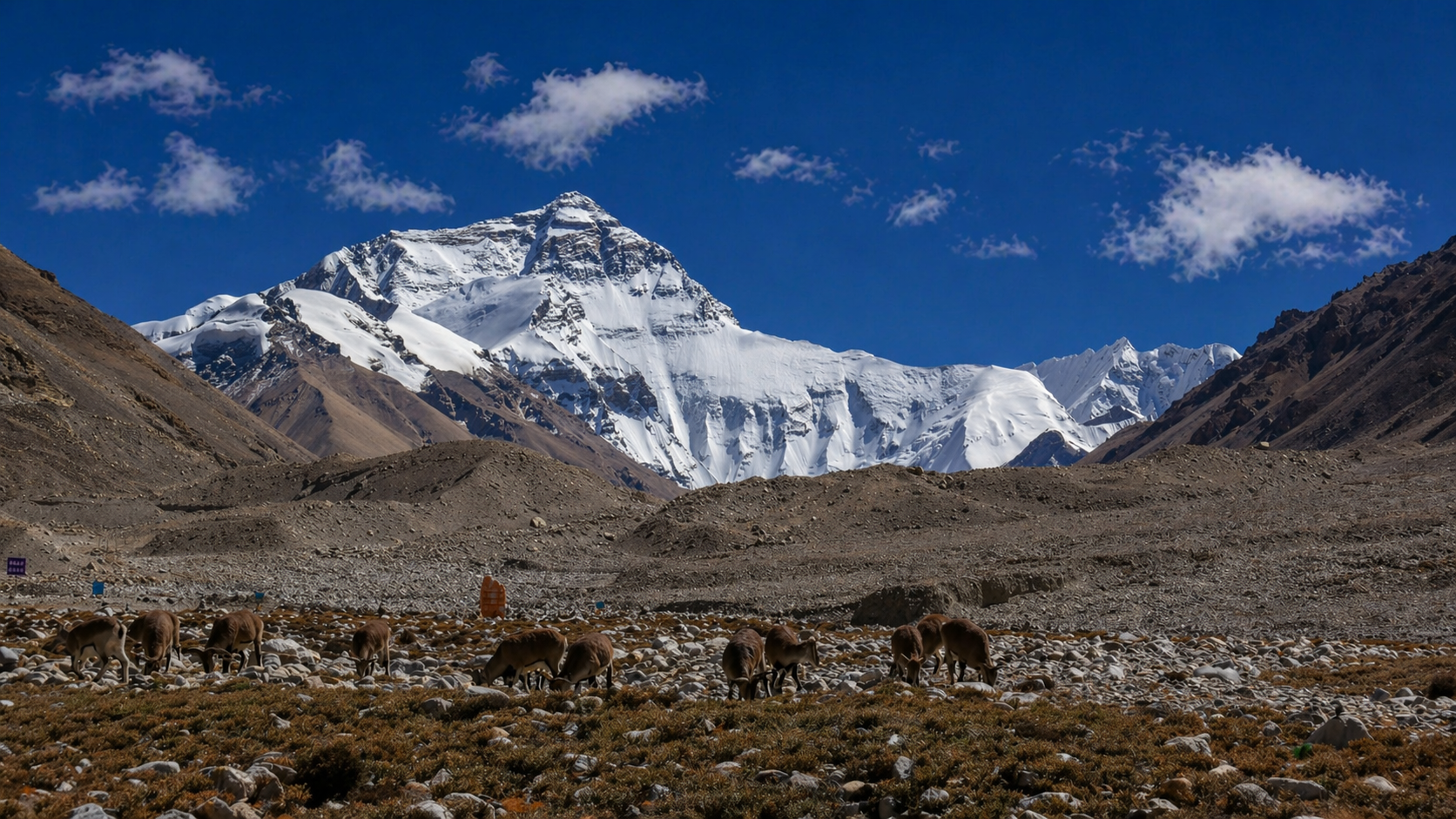
Then: Everest Base Camp. The North Face Base Camp on the Tibetan side sits at 5,000 meters, with an unobstructed view of the summit pyramid that no photograph fully captures. We arrive with your body properly acclimatized and your mind prepared — not gasping and disoriented, but present for one of the great natural spectacles on the planet.

The Return Route: Why We Go Through Sakya

Most Everest Base Camp tours return the same way they came — back along the Friendship Highway to Lhasa. Our 8-Day Unique Local Experience Everest Base Camp Tour takes a different road home, and the detour is worth every kilometer.

Sakya County sits southwest of Shigatse and is home to one of the most remarkable monasteries in all of Tibet. Sakya Monastery is immediately distinctive: its walls are painted in three vertical stripes of grey, white, and red — representing the Bodhisattvas Manjushri, Avalokitesvara, and Vajrapani. This color scheme is unique to the Sakya sect of Tibetan Buddhism and found almost nowhere else.

Inside, the monastery holds over 40,000 volumes of ancient Buddhist scriptures, many of them irreplaceable. The prayer flags here are of the Sakya tradition — different in design and ritual significance from the more commonly seen Gelug-tradition flags at Lhasa temples. Our guides, who have personal and scholarly familiarity with the Sakya tradition, bring this history to life in a way that a generic audio guide cannot.

This creative return loop is designed entirely by our native team. We know this road. We know the guesthouses, the most beautiful viewpoints, the hidden stops. And it ensures that you arrive back in Lhasa having seen a dimension of Tibet that most visitors — even repeat visitors — never encounter.

Tibet Travel Permits & Practical Logistics: Everything You Need to Know

This is the section that most travel blogs rush through or get wrong. I want to give you accurate, complete information, because understanding Tibet’s entry requirements is genuinely important to planning your trip.

Tibet Travel Permit: The Non-Negotiable First Step

Every foreign national who visits Tibet — no matter their nationality — must obtain a Tibet Travel Permit (also called the Tibet Tourism Bureau Permit or TTB Permit). This is separate from your Chinese visa and cannot be applied for by travelers directly. It must be arranged through a licensed Tibet travel agency, which is us.

Key facts about the Tibet Travel Permit:

  • Processing takes a minimum of 15 working days from the date we receive your confirmed booking and passport details
  • We handle the entire application on your behalf — you provide your documents, we do everything else
  • We strongly recommend confirming your tour booking at least 4–6 weeks before your departure date, especially during peak seasons (April–May, September–October)
  • The permit must be in physical hard copy for travelers entering Tibet by flight or overland from mainland China — your guide will hand it to you at the airport or hotel upon arrival
  • For travelers entering via Kathmandu (Nepal), the rules are slightly different: you enter on a Group Tourist Visa issued by the Chinese Embassy in Kathmandu, and the Tibet permit is coordinated with your flight to Lhasa. The physical permit rule is relaxed at this entry point but nowadays, you can also enter Tibet from Nepal with individual China visa or holding a China visa free policy country does not require a visa and they can also enter Tibet from Nepal, both by land or flight but if you take a flight to Lhasa from Kathmandu, you must have a permit photo copy to show it at Tribhuvan international airport when you check in the flight.

In addition to the base Tibet Travel Permit, travel to the Everest region requires an Alien’s Travel Permit and an Everest National Park Entry Permit. Our agency handles all three simultaneously as part of your booking.

Entering Tibet: Chengdu vs. Kathmandu vs. Train from Xining

Chengdu (recommended for most international travelers) Chengdu has the highest frequency of direct flights to Lhasa, with multiple daily departures. Flight time is approximately 2 hours. For travelers coming from North America, Europe, Southeast Asia, or Australia, connecting through Chengdu is typically the most flexible and cost-effective option.

Beijing, Shanghai, Guangzhou Flights exist but are less frequent. Chengdu remains the preferred hub.

Train from Xining (the scenic alternative) The Qinghai-Tibet Railway is one of the great train journeys in the world. Departing from Xining (accessible by high-speed rail from major Chinese cities), the train crosses the Tibetan Plateau over approximately 21 hours, climbing through grasslands, permafrost plains, and high-altitude passes. Oxygen is available in carriages. The scenery is extraordinary and genuinely prepares you emotionally and visually for what’s ahead. We actively recommend this option for travelers who have a flexible schedule and want a memorable arrival experience. Note: train tickets from other cities to Lhasa (bypassing Xining) tend to have less scenic routing and more limited availability.

Nepal (Kathmandu) Entry Flights operate from Kathmandu to Lhasa on Mondays, Wednesdays, and Fridays only — this calendar is fixed and must be built into your itinerary. The Gyirong (Gyirong Port) land border crossing is also available for travelers who wish to enter by road from Nepal, subject to current cross-border regulations. We advise all Nepal-entry clients on the current status of this crossing at time of booking.

Visa Requirements

For citizens of most EU, US, Canadian, Australian, and ASEAN countries, a standard Chinese tourist visa (L-class) is required. This must be applied for at your nearest Chinese embassy or consulate before departure — your passport must have at least 6 months validity.

Citizens of some countries (Brunei, Japan, and a handful of others) have had visa-free or visa-on-arrival arrangements with China at various times — check with us or your nearest Chinese consulate for the current rule, as these arrangements change.

One important myth to address: individual travel to Tibet is not permitted for foreign tourists. You must be part of an organized tour with a licensed agency. This is not a guidebook error — it is enforced policy. When we say an organized tour, it means, one person can also be an organized tour group so it is possible to arrange a solo traveler Tibet trip as well. Our customized Tibet private tour structure satisfies this requirement, and we handle all the associated permits.

Payment and Money in Tibet

For tour payments: Tibet Shambhala Adventure accepts international bank wire transfer (recommended for full tour packages), as well as PayPal for partial deposits. We’ll provide full banking details upon booking confirmation.

On the ground in Tibet: Tibet operates almost entirely on Alipay and WeChat Pay for daily transactions — restaurants, small shops, street vendors, monastery entrance fees. Foreign credit cards (Visa, Mastercard) are accepted at some larger Lhasa hotels but are unreliable elsewhere. We strongly recommend arriving with a supply of Chinese RMB (Yuan) in cash, which you can obtain at your home country’s bank, at Chinese airports, or at ATMs in Chengdu or Lhasa before heading into rural areas. Budget approximately ¥200–300 per day for personal spending (meals not included in the tour, shopping, tips).

WiFi and Connectivity in Tibet

Tibet’s hotel WiFi infrastructure is genuinely good — major hotels in Lhasa, Shigatse, and Gyantse typically offer solid connections at no extra cost. The challenge is platform access: China’s internet policy does not work Google, Facebook, Instagram, WhatsApp, YouTube, and most Western social media.

To stay connected with family, post to Instagram, or use Google Maps, you’ll need a VPN (Virtual Private Network), which must be downloaded and tested before you arrive in China, as VPN download sites are also blocked. Paid VPNs cost approximately USD $10–30 for a monthly plan. We recommend researching reputable options (ExpressVPN, NordVPN, and similar services are widely used by travelers) and setting one up before departure. This is not illegal for tourists, but the landscape changes periodically — plan ahead.

Local SIM cards with a Chinese data plan are available at Lhasa and are a worthwhile investment for navigation and backup connectivity.

What to Pack: The Practical Checklist for Tibet

Tibet’s environment is unlike anywhere else you’ve traveled, and preparation genuinely matters.

Sun Protection (non-negotiable) At 3,650–5,200 meters, UV radiation is intense year-round. Pack SPF 50+ sunscreen (enough for daily application, as it’s hard to find good foreign brands in Lhasa), UV400 sunglasses, and a wide-brim hat or buff for wind protection.

Layers, Not Heavy Single Pieces Temperatures swing dramatically between day and night, even in summer. A packable down jacket for evenings and high-altitude sections is essential. Moisture-wicking base layers, a mid-fleece, and a windproof outer shell cover most situations. Cotton is actively unhelpful at altitude.

Footwear Comfortable, broken-in hiking shoes or trail runners are sufficient for the standard itinerary. Full hiking boots recommended if you plan additional trekking. Warm socks — more than you think you’ll need.

Altitude Medication Consult your doctor before the trip about Acetazolamide (Diamox), which is widely used for altitude acclimatization. We also recommend carrying ibuprofen for headaches and a pulse oximeter (inexpensive, available online) to monitor your blood oxygen levels. Altitude sickness is real, and at Tibet Shambhala Adventure we monitor our guests’ health throughout the tour — but preparation from your side matters.

Photography Bring sufficient memory cards and a spare battery — cold temperatures drain batteries quickly, and charging opportunities are limited at nomad camp and EBC. A polarizing filter dramatically improves lake and sky shots. The best photography seasons are April–May (clear skies, spring light) and September–October (post-monsoon clarity, autumn colors). Summer (June–August) brings rain and cloud cover to lower areas; winter (November–February) is cold but often spectacularly clear, though some routes become restricted because of the snow fall.

Personal Items Lip balm (altitude and wind cause intense chapping), a reusable water bottle, hand sanitizer, and any personal medications in quantities that cover the full trip plus buffer. Pharmacies exist in Lhasa but selection of Western brands is limited.

Why Book With a Native Tibetan Agency — And Not Just Anyone Claiming to Be One

I want to close with something I feel strongly about, because the tourism industry in Tibet has a problem with honesty.

There are agencies based outside Tibet — in mainland China, in Nepal, in Western countries — that market themselves as “local Tibet specialists.” Some are well-intentioned but limited in their actual access and knowledge. Others are simply intermediaries who outsource everything to whoever gives them the best price. When something goes wrong — a permit delay, an altitude emergency, a guest who needs to leave a remote area quickly — the depth of those relationships matters enormously.

Tibet Shambhala Adventure has operated with the same core team — all native Tibetans — for 25+ years. We have genuine emergency protocols, real relationships with local health facilities and mountain rescue services, and zero tolerance for the shopping traps and commission-driven restaurant stops that plague many budget Tibet tours.

The Aku Tonpa Nomad Camp is perhaps the clearest example of what exclusive local access actually looks like. It took years of conversation, respect, and mutual trust to earn the Aku Tonpa family’s willingness to host foreign guests. We protect that relationship carefully — which means small group sizes, respectful conduct guidelines, and a genuine commitment to leaving the community better than we found it.

Our 8-Day Unique Local Experience Everest Base Camp Tour is not the cheapest option on the market. It’s the most complete, most authentic, and most responsibly designed one — built by people who call Tibet home.

Ready to Experience Tibet at Its Deepest?

If you’ve read this far, I think you’re looking for more than a bucket list check. You’re looking for the experience that changes how you understand the world — and yourself.

Our 8-Day Unique Local Experience Everest Base Camp Tour has limited availability each season, particularly the Aku Tonpa Nomad Camp dates, which can only host a small number of guests at a time.

The Tibet travel permit application process requires a minimum of 15 working days, so we recommend reaching out at least 4–6 weeks before your intended travel date to secure your spot and begin the paperwork.

Contact us:

  • 📧 Email: info@shambhala-adventure.com
  • 💬 WhatsApp: 00977-9764772598
  • 🌐 Request a free custom itinerary consultation — we’ll tailor the tour to your travel dates, group size, and specific interests

Tibet is waiting. Not the version in the brochure — the real one, alive and vast and unlike anywhere else on Earth. Come and find it with us.

Tibet Shambhala Adventure — Native Tibetan guides, 25+ years of local expertise, exclusive cultural access.


Tibet Motorcycle Adventure: The Ultimate 11-Day High-Altitude Motorbike Journey Across the Tibetan Plateau By Tibet Shambhala Adventure — Your Local Tibetan Expert

featured image

There are road trips, and then there is a Tibet motorcycle road trip. No other journey on Earth combines altitude, raw wilderness, ancient spirituality, and pure riding freedom quite like Tibet. As you embark on this adventure, you’re not just crossing a country — you’re crossing the rooftop of the world, riding at elevations that challenge your body, your machine, and your understanding of what adventure truly means.

For riders from Europe, North America, and Australia who have conquered the Alps, Route 66, or the mountain roads of Southeast Asia, Tibet represents the final frontier. This ride defines all other rides. This guide — written by Tibet Shambhala Adventure, a Tibetan-owned agency based in Lhasa — gives you everything you need to plan your Tibetan Plateau motorbike adventure: the exact route, necessary permits, gear, altitude strategy, and cultural encounters that transform a holiday into a life-changing story.

Why Tibet? The Case for the Roof of the World

Let’s be clear: Tibet is not an easy destination. The majority of the route sits between 4,000 and 5,220 meters above sea level. The weather can change rapidly. The logistics are complex. And the permits require careful planning. So why do serious motorcycle travelers consistently rank a Tibet high-altitude motorbike tour as the pinnacle of adventure riding?

Because difficulty is the point. And the reward is unlike anything else on Earth.

Riding across the Tibetan Plateau, you will pass through a landscape that feels both ancient and cosmic. The sky is a deep, almost impossible blue. The Himalayas rise like walls to another dimension. Rongbuk Monastery sits beneath the north face of Everest. Tibetan nomads with vast yak herds cross your path on endless grasslands. The silence between engine revs is profound. And in the old alleyways of Lhasa, pilgrims complete their devotions as they have for over a thousand years.

This isn’t just a motorcycle tour. It’s a journey that will change how you view the world.

Critical Visa-Free Entry Update (Effective February 17, 2026)

New Policy: As of February 17, 2026, travelers from Canada, the United Kingdom, and EU countries are now eligible for 30 days of visa-free entry to China for tourism purposes. This is a major update for Western motorbike travelers looking to explore Tibet.

  • Nationalities Included: Citizens of the UK, Canada, Australia, and nearly all EU countries (including France, Germany, Italy, and Spain) can now enter China visa-free for up to 30 days.
  • Nepal-Tibet Border: For these riders, no Chinese visa is required at all — you only need the Tibet Travel Permit and the motorbike-specific permits, which Tibet Shambhala Adventure will arrange.

For other nationalities, you can apply for a Chinese individual visa in your home country before departure.

Required Permits:

  • Tibet Travel Permit — managed by Tibet Shambhala Adventure
  • Motorbike License Permit
  • China Customs Permit for the motorbike
  • Temporary Tibetan Motorbike Driving License
  • Temporary Tibetan motorbike plate number

Please provide your passport and necessary documents at least one month in advance for the necessary processing.

The Route: 11 Days from Kathmandu to Everest Base Camp and Back

This loop tour is a masterpiece of road design, combining the most dramatic landscapes and cultural experiences of the Tibetan Plateau. The route takes you through Nepal, into Tibet via Kyirong and the Friendship Highway, past Yamdrok Lake, Karola Glacier, Gyantse, Shigatse, and Sakya, and finally to Everest Base Camp before looping back through Drila La Pass.

Stage 1: Kathmandu → Kyirong Border → Kyirong Town (Day 1)

Your adventure begins in Kathmandu, where your guide and support vehicle will meet you. After completing the immigration formalities at Sybrubesi, you’ll ride the 20km to Kyirong Town (2,800m), nestled in a beautiful gorge. The town is historically significant as the birthplace of Milarepa, one of Tibet’s greatest yogis and poets.

Stage 2: Kyirong → Pekutso Lake → New Tingri (Day 2)

Departing from Kyirong, you’ll begin your ascent onto the Tibetan Plateau. You’ll ride past Pekutso Lake, a shimmering turquoise lake, and ascend high mountain passes, reaching New Tingri at 4,050m — your first night on the roof of the world.

Stage 3: New Tingri → Shigatse (Day 3)

The journey continues across the plateau, with expansive views of the Himalayas. You’ll ride through Gyatso La Pass at 5,220m, the highest point of the outbound journey, and descend into Shigatse, Tibet’s second-largest city, at 3,800m.

Choosing Your Motorcycle for the Tibet Adventure

At Tibet Shambhala Adventure, we provide a variety of bikes for different riders:

  • Royal Enfield: The iconic choice for many. Known for its reliability and comfort on rugged roads.
  • Chinese Motorbikes (400cc+): After feedback from experienced riders, we now also offer these Chinese-made bikes, known for their smooth throttle response and reliable performance at high altitudes.
  • BMW 800cc-1200cc: For those seeking power and luxury, the BMW GS series provides a comfortable, powerful ride through Tibet’s rugged landscapes.

Safety, Mechanic Support, and Altitude Acclimatization

On-Site Mechanic & Safety: We provide a professional mechanic from Nepal who is always with the group to ensure any issues with the bikes are resolved immediately. Spare parts are carried in our support vehicle for peace of mind.

Altitude Acclimatization: We ensure proper acclimatization for all riders. You’ll spend your first nights in Kyirong (2,800m) and New Tingri (4,050m), followed by Lhasa (3,650m) before heading to Everest Base Camp.

Practical Information for Western Riders

  • Best Time to Ride: The ideal months are April, May, June, September, and October.
  • Currency: Chinese Yuan (CNY) is used in Tibet. Exchange your USD, EUR, or GBP at the Kyirong border, Shigatse, or Lhasa.
  • Food: Enjoy a variety of continental and Tibetan foods along the route.
  • Weather: Tibet’s weather is sunny and windy, with temperature swings from +20°C to -10°C at high altitudes. Bring sun protection and rain gear.
  • Conclusion: Why a Tibet Motorcycle Adventure Should Be on Your Bucket List

  • This Tibet Motorcycle Adventure is the ultimate journey for any motorbike enthusiast. With its high-altitude routes, rugged terrains, and stunning landscapes, Tibet offers a unique and thrilling adventure. Whether you’re riding the Friendship Highway, heading to Everest Base Camp, or exploring Western Tibet, this motorcycle tour promises to be a journey you will never forget.
  • About the Author: Dawa Tsering

  • Dawa Tsering is the founder and executive director of Tibet Shambhala Adventure, a leading Tibetan-owned travel agency known for offering authentic and tailor-made tours across Tibet. With over 25 years of experience in the tourism industry, Dawa is dedicated to providing unique travel experiences that showcase the beauty, culture, and spirituality of Tibet. His expertise in motorbike tours, along with his intimate knowledge of Tibet’s high-altitude routes, makes him a trusted guide for adventure seekers and cultural explorers alike. Dawa is passionate about sustainable tourism and ensures that his agency provides high-quality services, with a personal touch that reflects his deep connection to Tibet and its people.
  • Tibet is waiting. The road is open. The pass is yours.

    Book your Tibet Motorcycle Road Trip with Tibet Shambhala Adventure  |  www.shambhala-adventure.com


Why the Kangshung Valley Closure Should Change How You Think About a Tibet Trekking Tour with Local Guide

featured image
  • The Update: If you are planning a Tibet trekking tour with local guide, please note that as of March 2026, the Kangshung Valley and Kartha trekking routes are officially closed for environmental recovery.

  • The Impact: Permits for the East Everest region are suspended for the 2026 season. Standard Everest Base Camp and Mt. Kailash routes remain open.

  • The Expert Solution: Tibet Shambhala Adventure provides authorized permit handling and expert guidance for alternative private treks like the Gama Valley to ensure your journey remains authentic and legal.

There’s a particular kind of silence you only find in the eastern shadow of Everest — the kind every serious Tibet trekking tour with local guide is quietly chasing. Not the silence of an empty room — the silence of a glacier breathing. Of yak bells fading into a valley so wide it swallows sound. Of altitude doing what altitude does: stripping everything down to what actually matters.

That’s what Kartha trekking was. And as of late March 2026, it’s gone — at least for now.

If you’ve been researching a Tibet trekking tour with local guide and the Kangshung Valley was on your shortlist, this article will tell you exactly what happened, why it matters more than most travel sites are letting on, and what it means for the future of responsible trekking in Tibet.

What Happened to Kartha Trekking — and Why It Wasn’t a Surprise

The closure didn’t arrive out of nowhere. On March 12, 2026, a notice was issued concerning activity restrictions in the core and buffer zones of the Qomolangma National Nature Reserve in Dingri County. Commercial trekking operations on the Kartha and Kangshung Valley route were suspended for 2026. Local officials cited the need for stronger regulation — and left the long-term status deliberately ambiguous.

Most travel blogs reported this as unfortunate news. It was. But it was also overdue.

The warning signs had been building for years. The surge in domestic outdoor tourism across China brought thousands of new trekkers to routes once known only to serious mountaineers. Valleys that had managed a handful of disciplined international expeditions each season were suddenly absorbing group after group with very different attitudes toward waste management, camping practice, and route behavior.

Then, in October 2025, came the wake-up call nobody could ignore. Severe snowfall in Dingri County trapped hundreds of trekkers and support staff in the Gama Valley area. The rescue operation was enormous — personnel, vehicles, pack animals, supply chains, all mobilized at once. After an event like that, authorities weren’t going to look away again.

The closure, frustrating as it is for those who had planned trips, is a direct consequence of what happens when a fragile high-altitude ecosystem gets treated like a trail in a national park back home.

What Made Kartha Trekking So Special — and So Vulnerable

The Kangshung Valley route offered something the Rongbuk approach to Everest simply cannot: the eastern face. Massive. Shadowed. Barely touched by commercial tourism. Trekkers moved through alpine meadows and glacial moraines with views that genuinely stopped people mid-stride.

It was, in every sense, the kind of route that justifies a serious Tibet trekking tour with local guide rather than a packaged sightseeing loop. The terrain demanded real alpine logistics — yak support, acclimatization planning, experienced route judgment, and a guide who understands the difference between a passable day and a dangerous one.

That’s precisely why it was so difficult to protect once popularity arrived. The landscape that made Kartha trekking extraordinary — remote, high, glacially fragile — is the same landscape that cannot absorb careless behavior. At altitude, litter doesn’t break down. At altitude, a poorly placed camp can contaminate a water source that serves yak herders for generations. At altitude, a sudden weather change kills people.

The Kangshung Valley was being loved into damage. And now it’s closed.

The Garbage Problem Nobody Wanted to Talk About

Let’s be direct about something the official announcements only gestured at: the garbage crisis on remote Tibetan trekking routes has been an open secret in the trekking community for several years.

When a spectacular route becomes fashionable quickly, the management infrastructure almost never keeps pace. Proper waste systems, trained guides, enforced campsite protocols, group size limits — these take time and institutional will to build. Meanwhile, the trekkers keep coming.

A properly run Tibet trekking tour with local guide from a serious operator will handle this correctly. Camp protocol, human waste management, strict pack-out rules, yak loading systems that account for waste removal — these aren’t optional extras. They’re the baseline of responsible operation at altitude.

The problem is that not every company running treks in Tibet operates at that standard. And not every trekker chooses their operator based on environmental practice rather than price.

The Kartha closure is partly the price of that gap.

What This Means If You’re Planning a Tibet Trek Right Now

If Kangshung Valley was on your itinerary for 2026, treat it as unavailable. Some sources suggest the closure may not be permanent, but planning around that uncertainty would be a mistake. The route is off the table for this season, and potentially beyond.

That said, a closed route doesn’t mean a cancelled adventure. Tibet is vast, and the trekking options that remain open are genuinely extraordinary. The key is working with operators who understand both the landscape and the legal and logistical realities on the ground — which is exactly why your choice of a Tibet trekking tour with local guide matters more than ever right now.

Here’s what to look for when evaluating your options:

Route legality and permit status — Routes and access permissions in Tibet shift more frequently than many trekkers realize. A good local guide will know what’s currently open, what’s been restricted, and why. If an operator is vague about permits, that’s a red flag.

Group size and waste management — Ask specifically. How many trekkers per group? What’s the waste protocol? Are yaks or porters responsible for carrying refuse out? Operators who take these questions seriously are the ones you want.

Acclimatization days — Tibet’s altitude demands respect. Any itinerary that rushes acclimatization to fit in more stops is prioritizing itinerary design over your safety.

Emergency planning — After the Gama Valley rescue of October 2025, this is non-negotiable. What’s the evacuation plan? Does your guide have communication equipment? What’s the protocol if weather closes a route?

A genuine Tibet trekking tour with local guide answers all of these questions before you ask them, because a serious operator has already thought them through.

Why Your Guide Is the Most Important Decision You’ll Make

There’s a version of “local guide” that means someone who carries a flag and points at mountains. That’s not what we’re talking about.

A real Tibetan guide on a proper Tibet trekking tour with local guide brings layered knowledge that no amount of research from home can replicate. They know which passes are safe this week, which river crossings are running high, and which yak herder family can offer emergency shelter in a valley that doesn’t appear on any tourist map. They understand the altitude in their body, not just their head — and they can read yours.

They also bring cultural context that transforms the experience. The mountains in Tibet aren’t scenery. They’re personalities, deities, sacred anchors of Tibetan cosmology. A valley like Kangshung isn’t just geologically dramatic — it’s spiritually significant. A good guide doesn’t just tell you that. They show you how to move through a landscape that deserves more than a camera pointed at it.

This is the difference between trekking in Tibet and trekking through Tibet. The first is an activity. The second is a relationship.

The Broader Lesson the Kartha Closure Is Teaching Us

Here’s the uncomfortable truth: the closure of Kartha trekking isn’t just about one valley. It’s a signal about the direction of travel (in every sense) in remote Himalayan tourism.

The era of “the more remote, the better” is running into hard limits. Not because the places have changed, but because the volume of people chasing remoteness has changed. When a thousand people all seek the same unspoiled valley, it ceases to be unspoiled. The paradox is brutal and real.

The trekkers who will still be doing meaningful routes in Tibet in ten years are the ones who learned to ask different questions now. Not “what’s the most dramatic route I can access?” but “what’s the most thoughtful way I can travel in this landscape?” Not “how do I find a cheap local guide?” but “how do I find a guide who will make this trip genuinely responsible?”

A great Tibet trekking tour with local guide doesn’t just take you somewhere beautiful. It makes you a better traveler in a landscape that needs better travelers.

What to Do Next

If you’re planning a Tibet trek and working through your options after the Kartha closure, here’s practical advice:

Don’t chase the closure — don’t contact operators promising underground access to closed routes. The risk (legal, safety, environmental) isn’t worth it.

Start the conversation early — permit windows and logistical lead times in Tibet are real. A serious Tibet trekking tour with local guide requires planning months in advance, not weeks.

Be honest about your fitness and altitude experience — Tibet is not a beginner trekking destination. A good operator will tell you this directly.

Ask about their environmental track record — operators who’ve been doing this well for years have stories to tell and practices to describe. Ones who can’t answer this question specifically probably haven’t thought about it.

Think about what kind of traveler you want to be — not in a self-congratulatory way, but practically. The Kartha closure happened partly because not enough people asked that question before heading into the Kangshung Valley.

Final Thoughts: The Mountains Aren’t Going Anywhere — But Access Might Be

Kartha trekking is closed. The Kangshung Valley’s eastern face of Everest is still there, more dramatic than ever, completely indifferent to our schedules. What’s changed is access — and access, in Tibet, has always been a privilege rather than a right.

The future of meaningful trekking in this region belongs to people and operators who understand that. To travelers who choose a Tibet trekking tour with local guide not because it’s the most efficient way to tick off a bucket list item, but because they genuinely want to engage with a landscape and a culture on its own terms.

Tibet’s mountains have been here for forty million years. They’ll outlast any trend in adventure tourism. The question is whether we leave them in better shape than we found them — and whether the routes we love today are still there for the travelers who come after us.

That’s not a romantic sentiment. That’s the only sustainable logic for trekking in one of the most fragile and sacred high-altitude environments on the planet.

Choose your operator wisely. Travel with real local knowledge. Respect the closures when they come. And when a valley opens again, arrive as the kind of traveler that deserves to be there.

Planning a trek in Tibet and unsure which routes are currently open and properly permitted? A responsible Tibet trekking tour with local guide starts with that conversation — and the right operator will have honest, up-to-date answers before you book a single flight.


Why Visit Mount Kailash in Horse Year 2026? A Once-in-a-Lifetime Sacred Journey By a Tibetan Travel Specialist | Updated 2026

featured image

I have been organizing Mount Kailash pilgrimages for over twenty years. I have watched engineers from Seoul weep quietly at Dolma La pass. I have seen a retired schoolteacher from USA — who told me on day one she would never make it — complete the full kora without stopping. Every single journey has surprised me. But nothing surprises me more than when people ask me which year to go. Because the answer, right now, is simple.

If you have been putting off this pilgrimage, 2026 is the year to stop waiting. This is the Tibetan Horse Year — and if you understand what that means for a Mount Kailash pilgrimage, you will understand why serious pilgrims from across Asia are already booking their journeys months in advance.

What Makes Horse Year 2026 So Spiritually Significant?

To understand why visit Mount Kailash in Horse Year 2026 matters so much, you first need to understand the Tibetan zodiac — and specifically, the relationship between the Horse Year and the sacred mountain itself.

According to Tibetan Buddhist tradition, Mount Kailash is the earthly home of Demchog (Chakrasamvara), one of the most powerful tantric deities. The Horse is Demchog’s animal. This is not metaphor — it is the reason why the Horse Year Kailash kora carries spiritual weight unlike any other year in the 12-year cycle.

Completing one kora during Horse Year is said to carry the merit of 13 koras in an ordinary year. For devout Buddhists and Hindus alike, this is not a small thing.

I have led groups during Horse Year before — the last one was 2014 — and the atmosphere genuinely feels different. There are more pilgrims on the trail, more prayer flags being raised, more monks performing rituals at dawn. Whether you believe in the spiritual mathematics or not, the collective energy is something you feel in your chest.

Why visit Mount Kailash in Horse Year 2026? Because this window closes and does not reopen for another 12 years.


Mount Kailash: More Than a Mountain

I want to be honest with you about something: Mount Kailash is not the most beautiful mountain I have ever seen. Tibet has dozens of peaks that will steal your breath before Kailash even comes into view. It is not the tallest. It has never been climbed, and climbing it is forbidden.

And yet — there is no mountain on earth quite like it.

At 6,638 metres, Kailash rises from the Tibetan plateau with an almost unnatural symmetry. Four great rivers are born from its glaciers: the Indus, the Brahmaputra, the Sutlej, the Karnali. Buddhists, Hindus, Jains, and Bon practitioners have considered it the axis of the universe for thousands of years. These are four separate religious traditions, from completely different cultural roots, all pointing at the same mountain and saying: this is the center.

That convergence alone should make you curious. But if you are reading this and asking why visit Mount Kailash in Horse Year 2026, I suspect you already feel something pulling you toward this place — you are just looking for confirmation.

I tell every client the same thing before departure: you are not going to Kailash to conquer anything. You are going to understand something about yourself that ordinary life never quite gives you the space to see.


The Kailash Kora: What the Journey Actually Feels Like

Day One — The Ground Beneath Your Feet

The kora begins at Darchen, a small settlement at around 4,600 metres. Most people feel the altitude before they feel anything spiritual. Your head is heavy. Your pack is too. The trail stretches ahead along a valley floor that looks deceptively gentle.

This first day is 20 kilometres. You pass mani walls carved with prayers, streams so cold your fingers go numb if you dip them in, and yaks moving slowly across the slopes above. By late afternoon, when you reach the camp at Dirapuk, the north face of Kailash is directly in front of you — enormous, close, and completely silent.

Most people do not speak much at dinner that night.

Day Two — Dolma La Pass

This is the hardest day. The Dolma La pass sits at 5,636 metres — the highest point of the kora and, for many pilgrims, the most emotionally significant. The climb is steep. The air is thin. Around you, Tibetan pilgrims are prostrating the entire length of the trail, their bodies pressing against the cold stone with each prayer.

I have watched people cry at Dolma La. Not from exhaustion, though they are exhausted. They cry because something releases up there. Twenty years of watching this happen, and I still cannot explain it properly. Something about the altitude, the effort, the community of strangers all moving in the same direction — it strips away whatever you arrived carrying.

The Horse Year 2026 Kailash pilgrimage will see more pilgrims on this pass than in most years. That shared energy makes the crossing even more powerful.

Day Three — Coming Down

The final day is gentler — 14 kilometres descending back toward Darchen. Most people are quiet. A few are already trying to figure out how to come back.


Saga Dawa Festival: Timing Your Mount Kailash in Horse Year 2026 Visit

If there is one piece of advice I give to every client planning a Mount Kailash Horse Year 2026 journey, it is this: if you can possibly arrange it, arrive during Saga Dawa.

Saga Dawa falls in the fourth month of the Tibetan lunar calendar — typically May or June in the Gregorian calendar. It commemorates the birth, enlightenment, and parinirvana of the Buddha Shakyamuni. During Horse Year, Saga Dawa and the spiritual amplification of the kora overlap in a way that happens once in 12 years.

The centerpiece of the festival is the raising of the Tarboche flagpole — a 30-metre prayer pole near Darchen that is lowered, re-wrapped with thousands of prayer flags, and raised again while monks chant and pilgrims circle in the dust below. I have seen it happen many times. It never gets ordinary.

The combination of Horse Year and Saga Dawa is the reason why visit Mount Kailash in Horse Year 2026 is a question that serious pilgrims are asking months, sometimes years, in advance.


Lake Mansarovar: The Soul’s Mirror

No honest account of a Mount Kailash pilgrimage leaves out Mansarovar. And yet it is the hardest part to write about.

The lake sits at 4,590 metres — one of the highest freshwater lakes in the world. On a clear morning, it is so still that the sky and the mountains around it appear twice: once above, once below. The water is an impossible shade of blue. There are no boats, no engines, almost no sound.

I had a client — a businessman from Singapore who had not taken more than four days off work in a decade — who sat at the edge of Mansarovar for two hours without moving. Afterward he told me: ‘I think I forgot what quiet felt like.’

If you are planning your Mount Kailash in Horse Year 2026 journey, build in at least one full day at Mansarovar. Do not rush it. The lake rewards patience in ways that are very difficult to describe before you experience them yourself.


Who Should Make This Journey?

I want to be straightforward here, because I believe in honest travel advice: a Mount Kailash pilgrimage is not for everyone, and that is not a criticism of anyone.

The altitude alone rules out some travelers — if you have serious heart or lung conditions, Kailash is genuinely risky without medical consultation. The kora itself is 52 kilometres over three days at high altitude. You do not need to be an athlete, but you need to be reasonably fit and willing to push through discomfort.

What you do not need is prior religious belief. Some of my most profound clients have been agnostics who came purely out of curiosity. The mountain does not seem to care very much about your theology. It cares whether you show up with some degree of openness.

Why visit Mount Kailash in Horse Year 2026? Because if you are the kind of person who has been thinking about this journey for years and keeps finding reasons to delay — this is the year to stop delaying. The Horse Year will not come again until 2038.


Practical Guide: Planning Your Horse Year 2026 Mount Kailash Trip

Permits and Documentation

Tibet is not a place you can simply book a flight and show up. You will need a Chinese visa, a Tibet Travel Permit, an Alien’s Travel Permit for the Kailash region, and in some cases a Military Area Permit. The permit process has changed over the years and continues to be subject to policy shifts — this is one of the main reasons working with an experienced Tibetan operator matters.

Best Time to Go

The Kailash region is accessible roughly from end of April through October. The sweet spot for most travelers is May–June (overlapping with Saga Dawa) or August–September, when the monsoon rains are less disruptive to the western plateau. The Horse Year runs through 2026, so the spiritual significance applies throughout the accessible season.

Acclimatization

This is non-negotiable. Spend at least two nights in Lhasa before heading west. Some operators rush clients through — do not let them. Altitude sickness at Dolma La with inadequate acclimatization is not a spiritual experience. It is a medical emergency.

What to Bring

Layers, always layers. The temperature on the kora can swing 20 degrees between morning and afternoon. Waterproof everything. Trekking poles are not just for the weak — they are genuinely useful on the ascent to Dolma La. And bring far less than you think you need: your porter will thank you, and so will your knees.


Why Visit Mount Kailash in Horse Year 2026: The Honest Answer

I have been writing and speaking about this pilgrimage for two decades, and I want to end with something simple.

There is a version of this article that fills your head with statistics about spiritual merit and festival dates and permit requirements. All of that is useful. But it is not really why people go to Kailash.

People go because they are looking for something that normal life has stopped providing. Not drama or adventure — there are easier places for that. Something quieter. A sense of scale, maybe. A moment where the noise in your head becomes less insistent than the wind coming off the mountain.

Mount Kailash in Horse Year 2026 is significant because of the spiritual tradition surrounding it, because of the Saga Dawa festival, because of the 12-year cycle that makes this year more auspicious than most. All of that is real and worth knowing.

But the deeper answer to why visit Mount Kailash in Horse Year 2026 is this: because the mountain has been there for millennia, and it will be there long after all of us are gone, and there is something deeply settling about standing in the presence of something that large and that indifferent to your ordinary concerns.

Go this year if you can. Go with patience, with reasonable fitness, and with the willingness to be surprised. Kailash has a way of giving people exactly what they did not know they needed.

Questions about planning a Mount Kailash Horse Year 2026 pilgrimage? Reach out — I am happy to share what I know.


© 2026 | Mount Kailash Pilgrimage Guide | Tibet Travel Specialist

How to Travel to Mt. Kailash in the Horse Year 2026: The Ultimate Pilgrimage Guide

featured image

How to Travel to Mt. Kailash in the Horse Year 2026: The Ultimate Pilgrimage Planning Guide
Everything you need to know about the Kailash Mansarovar Yatra in Tibet’s most auspicious year — permits, accommodation, timing, porters, and choosing the right tour company
There are journeys, and then there is the Kailash pilgrimage. If you have been asking yourself how to travel to Mt. Kailash in the Horse Year 2026, you are already thinking about one of the most spiritually significant journeys available to any traveler on Earth. In 2026, the sacred trek around the holy mountain carries a weight unlike any other year. According to Tibetan Buddhist tradition, the Year of the Horse is considered the most auspicious cycle in which to complete the kora — the ritual circumambulation — around Mount Kailash. Completing the 52-kilometer circuit in this year is believed to carry the merit of 12 ordinary koras. It is no surprise, then, that pilgrims and travelers from across the world are already making plans for their Mt. Kailash tour in the Horse Year 2026 with deep intention and careful preparation.
But with great spiritual reward comes great logistical challenge. The Year of the Horse draws exponentially larger crowds than a typical season — Indian pilgrims, Tibetan devotees, Chinese tourists, and international trekkers all converge on a remote corner of western Tibet that is already stretched thin in terms of infrastructure. This guide was written specifically for those who want to understand how to travel to Mt. Kailash in the Horse Year 2026 the right way: with every permit in order, every room pre-booked, every porter confirmed, and every risk understood before you leave home.
Why 2026 Is the Most Sacred Year to Complete the Kailash Kora
In Tibetan cosmology, Mount Kailash — known as Gang Rinpoche, or the “Precious Snow Mountain” — is the earthly abode of Lord Shiva in Hindu tradition and the cosmic throne of Demchog in Tantric Buddhism. Every 12 years, when the Tibetan lunar calendar enters the Year of the Horse, Mt. Kailash is said to be at its most spiritually potent. The mountain’s divine energy is believed to be fully awakened, and pilgrims who walk its sacred circuit during this window are said to wash away the accumulated karma of a lifetime in a single journey.
The last Horse Year was 2014. Thousands of pilgrims who made the journey that year speak of it as a transformative experience unlike any other. In 2026, the scale of pilgrimage is expected to be considerably larger — global awareness of the Kailash Mansarovar yatra has grown, travel to Tibet has become more accessible, and the appetite for meaningful spiritual journeys has never been stronger. Understanding how to travel to Mt. Kailash in the Horse Year 2026 — and doing so responsibly — is the difference between a deeply fulfilling pilgrimage and a chaotic, under-prepared disaster.
Start Planning at Least One to Three Months in Advance
One of the most important answers to the question of how to travel to Mt. Kailash in the Horse Year 2026 is simply this: start now. The permit process for Tibet is complex, multi-layered, and time-consuming under normal circumstances. In a Horse Year, when demand is multiplied many times over, the system faces enormous pressure. We strongly recommend beginning your preparations at least one full month before your intended departure — and ideally two to three months ahead to ensure the smoothest possible experience.
Those who delay their planning until the months immediately before travel will face a compounding set of problems: unavailable permits, fully booked guesthouses, no porters or yaks left for hire, and inflated last-minute prices across the board. Every experienced Tibet travel operator gives the same advice to anyone serious about the Kailash pilgrimage in 2026 — the window to act is now, not later.
All the Permits You Need for Mt. Kailash
Traveling to western Tibet and Mt. Kailash requires multiple layers of official documentation, all of which must be arranged in the correct sequence through a licensed Tibetan tour company:
• Chinese Visa — Obtained from your nearest Chinese embassy or consulate. This must be secured before any Tibet permits can be processed.
• Tibet Travel Permit (TTP) — The foundational permit required to enter the Tibet Autonomous Region. Can only be applied for through a licensed Tibetan tour operator in Lhasa. Processing takes 10–15 working days.
• Alien’s Travel Permit (ATP) — Required for all foreign travelers venturing outside Lhasa into restricted zones. Mt. Kailash is firmly in this category.
• Military Area Permit — Western Tibet, near the sensitive borders with India and Nepal, requires this additional clearance.
• Kailash Special Permit — A dedicated permit specifically for the Mt. Kailash kora area. Processing times increase significantly in Horse Years due to the volume of applications.
Not a single one of these permits can be self-arranged by a foreign traveler. All must go through a licensed Tibet tour company — which is precisely why choosing the right operator is not just a convenience, but a legal necessity.
The Accommodation Crisis: Book Your Rooms Before It Is Too Late
When people ask how to travel to Mt. Kailash in the Horse Year 2026, they are often focused on permits and logistics — but accommodation is the issue that catches the most travelers completely off guard. The guesthouses and small hotels along the route to Kailash, and especially those around the kora itself, have always been modest and limited. In 2026, they are being pushed to their absolute breaking point.
Towns along the overland route from Lhasa to Kailash — Saga, Paryang, Hor Qu, and Darchen — serve as essential overnight stops. All of them have seen dramatic price increases for the 2026 season. Reports from operators on the ground confirm that guesthouse and hotel rates have risen very significantly compared to previous years, and rooms in many of these towns are already being claimed by tour groups who began booking as early as late 2025.
The situation along the kora itself is even more severe. The guesthouses at Dirapuk (on the north face of Kailash, at approximately 4,900 meters) and Zuthulpuk (on the eastern side, at 4,790 meters) — the two mandatory overnight stops on the three-day circuit — have a very small total bed capacity. On peak dates during the Horse Year 2026, demand will outnumber available beds by a factor of many times over. Travelers without pre-confirmed accommodation may face sleeping in unheated tents at altitude with no alternative.
The message is clear: if you are researching how to travel to Mt. Kailash in the Horse Year 2026, securing accommodation must be among the first things you arrange — not an afterthought. Work only with a tour operator who can give you confirmed, written proof of room reservations before you pay your deposit.
Porters, Yaks, and Horses: Scarce Resources in a Crowded Year
The Kailash kora crests at 5,630 meters at the Drolma La pass, making it one of the most physically demanding pilgrimage circuits in the world. Many travelers — particularly those who are older, less physically fit, or suffering from altitude effects — rely heavily on porters to carry their bags, or on yaks and horses to assist with luggage or even transport the pilgrim in emergencies.
In the Year of the Horse, the number of available porters, yak-men, yaks, and horses around the Kailash kora is critically limited relative to the scale of demand. The nomadic communities based around Darchen and the surrounding high-altitude valleys simply cannot multiply their available livestock and labor to match a Horse Year surge. If your tour operator has not specifically reserved these support services in advance, you could arrive at Darchen and find nothing available at any price.
This is a genuine safety concern — not merely a comfort issue. For pilgrims above 60 years of age, those with heart or lung conditions, or anyone trekking at extreme altitude for the first time, porter and yak support can be the difference between completing the kora safely and requiring an emergency evacuation. As you plan how to travel to Mt. Kailash in the Horse Year 2026, demand explicit written confirmation from your operator that these resources are secured for your group.
Avoid the Saga Dawa Festival Period: Beautiful but Overwhelmingly Crowded
Saga Dawa is the holiest festival in the Tibetan Buddhist year, marking the anniversary of the Buddha’s birth, enlightenment, and passing — all on the same lunar date. In an ordinary year it draws large numbers of pilgrims to Kailash. In the Horse Year 2026, Saga Dawa will bring a convergence of pilgrims unlike anything seen in a decade. The festival falls in late May to mid-June, with the full moon marking the absolute peak.
During Saga Dawa 2026, the Kailash kora trail will be packed wall to wall with Tibetan pilgrims doing prostrations, large organized groups of Indian yatris, Chinese Buddhist tour buses, and international travelers. The result is a severe bottleneck — especially at the Drolma La pass — combined with fully booked guesthouses, dramatically inflated daily rates, exhausted porters and yak owners, and a trekking environment that feels far more like navigating a pilgrimage crowd than communing with a sacred mountain.
For those who have carefully thought through how to travel to Mt. Kailash in the Horse Year 2026 and want a more personally meaningful experience, we strongly recommend timing your journey either before Saga Dawa — late April to mid-May — or in the calmer window that opens after it, from late June onward. The auspicious merit of the Horse Year does not require the Saga Dawa date; it flows through the entire year.
Physical Preparation: Your Body Must Be Ready Before You Arrive
The Kailash pilgrimage is not an ordinary trek. Three consecutive days above 4,500 meters, with a single day cresting 5,630 meters, will test even experienced high-altitude trekkers. For anyone who is new to altitude trekking, proper physical preparation is not optional — it is essential. Begin your training regimen at least one full month before departure, and ideally six to eight weeks for those starting from a sedentary baseline.
A practical one-month preparation plan:
• Daily walking and hiking: Start at 5 km per day and progressively build to 15–20 km. Always include uphill stretches to simulate the kora’s demands.
• Cardiovascular training: Cycling, swimming, or running four to five times per week to build sustained aerobic capacity for altitude.
• Lhasa acclimatization: Every well-structured tour itinerary for how to travel to Mt. Kailash in the Horse Year 2026 should include at least two nights in Lhasa (3,650 m) before proceeding westward.
• Medical consultation: Visit your doctor for a complete fitness assessment. Discuss Diamox (Acetazolamide) for altitude sickness prevention — carry it regardless of whether you plan to use it.
• Essential gear: Thermal layering system, down jacket, sleeping bag rated to at least -10°C, quality trekking poles, glacier sunglasses, high-SPF sun protection, personal medications, and water purification.
Choosing the Right Tibet Tour Company: The Decision That Defines Your Journey
Of all the questions surrounding how to travel to Mt. Kailash in the Horse Year 2026, none carries more practical weight than this: who is going to take you there? Because all Tibet permits must legally be processed through a licensed Tibetan tour operator, every foreign traveler is dependent on their chosen company for the most fundamental aspects of the journey — permits, accommodation, transport, guides, and emergency support.
The Tibet tour market contains a wide spectrum of operators. At one end are highly experienced, officially licensed companies based in Lhasa, with deep relationships with local guesthouses, yak owners, porters, and government offices. At the other end are intermediaries who have little ground presence and subcontract everything at a markup. In a normal year, the difference between these two types of operator is significant. In the Horse Year 2026, when every resource is strained and every booking is contested, the difference could determine whether your pilgrimage happens at all.
What to look for when choosing your Tibet Kailash tour operator:
• Official TTB License: The company must hold a current and valid Tibet Tourism Bureau license. Request a copy and verify it.
• Horse Year experience: Operators who ran Horse Year tours in 2014 and 2002 have irreplaceable knowledge of managing the unique pressures of this cycle.
• Lhasa-based physical office: A company with a real office in Lhasa has direct, in-person access to government permit departments and established supplier relationships that remote agencies cannot replicate.
• Day-by-day itinerary with confirmed accommodation: Any trustworthy operator should be able to show you exactly where you will sleep each night along the route, with confirmation in writing.
• Independent verified reviews: Look beyond the operator’s own website. Seek reviews on independent travel forums, Google, or TripAdvisor. Ask directly to speak with past clients if possible.
• Emergency protocols: The operator must have clear procedures for altitude sickness evacuation and medical emergencies in remote western Tibet, where the nearest hospital is many hours away.
The Three-Day Kailash Kora: What You Will Actually Experience
The Kailash kora is a 52-kilometer clockwise circumambulation that begins and ends in Darchen, the small gateway town at 4,560 meters on the southern flank of the mountain. Most international pilgrims complete it over three days, though devout Tibetan pilgrims often do it in a single long day, and some take many weeks performing full-body prostrations along every meter of the route.
• Day 1 — Darchen to Dirapuk Guesthouse (North Face, ~4,900 m): Approximately 20 km through the Lha Chu river valley. The north face of Mt. Kailash reveals itself in full as you approach Dirapuk — one of the most breathtaking vistas in the Himalayas. Physically, this is the most approachable of the three days.
• Day 2 — Dirapuk to Zuthulpuk via Drolma La Pass (5,630 m): The heart and hardest test of the kora. The pre-dawn ascent to Drolma La is steep, cold, and unforgiving at altitude. The descent through the Lham Chu valley to Zuthulpuk guesthouse (4,790 m) demands mental as much as physical endurance. This day will define your Horse Year pilgrimage.
• Day 3 — Zuthulpuk to Darchen: A 14-km descent back to Darchen, completing the sacred circuit. Most pilgrims arrive back with deep physical tiredness and an equally profound sense of spiritual completion.
Lake Mansarovar: The Sacred Heart of the Yatra
No Kailash Mansarovar yatra is truly complete without time spent at Lake Mansarovar, one of the highest freshwater lakes on Earth at 4,590 meters elevation. Positioned just south of Mt. Kailash, the lake is considered the most sacred body of water in both Hindu and Tibetan Buddhist traditions. Hindu pilgrims perform ritual bathing in its impossibly cold waters. Tibetan Buddhists walk its approximately 85-kilometer shoreline in circumambulation.
Any well-designed itinerary for how to travel to Mt. Kailash in the Horse Year 2026 should include one or two nights camped or guesthouse-based at Mansarovar before beginning the kora. Beyond its deep spiritual significance, Mansarovar serves a practical purpose: resting here for a day provides an additional acclimatization step before the more demanding trekking begins.
Best Time to Go in 2026: Choosing Your Window Wisely
The Mt. Kailash trekking season runs from late April to early October. Within this window, the timing of your visit dramatically affects the quality of your experience:
• Late April to mid-May: Cool, quieter, some snow possible at Drolma La but generally passable. Excellent for those seeking a more contemplative kora.
• Late May to mid-June (Saga Dawa): Extremely crowded with Indian pilgrims, Chinese groups, and Tibetan devotees. Avoid unless the festival atmosphere is specifically what you seek.
• Late June to August: Post-Saga Dawa calming, clear skies, good mountain visibility. Moderately busy but well within manageable limits.
• September to early October: Crisp autumn air, spectacular visibility, and noticeably fewer crowds. An ideal window for experienced trekkers who have carefully planned how to travel to Mt. Kailash in the Horse Year 2026 and want the finest possible experience.
The Pilgrimage Begins Before You Leave Home
The ancient texts say that Mount Kailash cannot be climbed — it can only be honored. The kora is not an achievement to be completed; it is a surrender to be offered. And in the Year of the Horse 2026, when hundreds of thousands of pilgrims from dozens of traditions make their way to the high plateau of western Tibet to walk in reverent circles around a mountain of ice, rock, and sacred silence, that surrender becomes something shared — a collective act of faith at the top of the world.
But surrender still requires preparation. The answer to how to travel to Mt. Kailash in the Horse Year 2026 is not found only in spiritual readiness — it is found in permits filed months early, accommodation booked before the season opens, porters and yaks confirmed in writing, a body trained for extreme altitude, and above all, a licensed, experienced, Lhasa-based Tibet tour company who has the relationships and the knowledge to make the journey happen exactly as it should.
The mountain has waited 12 years for this Horse Year. Do not let late planning be the reason you miss it.
Essential Planning Checklist for the Mt. Kailash Horse Year Pilgrimage 2026
• Begin all preparations at least 1–3 months before your departure date
• Obtain your Chinese visa first — no Tibet permit processing can begin without it
• Book all accommodation along the Lhasa–Kailash route now — rooms are already filling fast
• Get written confirmation of porter and yak availability from your tour operator before paying any deposit
• Avoid the Saga Dawa period (late May–mid-June) unless festival crowds are specifically what you want
• Begin physical training at least one month before departure — prioritize hiking, cardio, and altitude awareness
• Choose only a fully licensed, Lhasa-based Tibet tour company with verifiable Horse Year experience
• Ensure your itinerary includes Lhasa acclimatization days (minimum two nights) before westward travel
• Include Lake Mansarovar nights in your itinerary for spiritual depth and additional acclimatization
• Pack for extreme altitude cold: -10°C sleeping bag, thermal layers, trekking poles, high-SPF sun protection

10 Days Tibet Culture & Nature Tour

featured image

10 Days Tibet Culture & Nature Tour:
Why Tibet Shambhala Adventure Is the Right Choice for Your Tibet Journey
A Complete Guide to Planning Your Tibet Tour with Confidence
Tibet Travel: A Dream That Deserves the Right Guide
Planning a Tibet tour is not like booking an ordinary holiday. Tibet is one of the most regulated, most remote, and most logistically complex travel destinations in the world — and yet it is also one of the most profoundly rewarding. For travelers who have long dreamed of standing at the foot of the Himalayas, walking the pilgrim circuit of the Jokhang Temple, or watching the sun rise over the sacred waters of Namtso Lake, the 10 Days Tibet Culture & Nature Tour represents something far more significant than a two-week vacation. It represents the fulfillment of a lifelong aspiration.
But traveling to Tibet successfully — and meaningfully — requires more than just a flight ticket and an adventurous spirit. It requires permits, local expertise, deep cultural knowledge, reliable logistics, and above all, a travel partner who understands Tibet not merely as a destination to be ticked off a bucket list, but as a living, breathing civilization that deserves to be encountered with respect, curiosity, and care. That is precisely what Tibet Shambhala Adventure was built to provide. And the 10 Days Tibet Culture & Nature Tour is the flagship expression of everything we stand for as a company dedicated to authentic, responsible, and deeply enriching Tibet travel.
Who Is Tibet Shambhala Adventure?
Tibet Shambhala Adventure is a locally owned and operated Tibet travel company headquartered in Lhasa, Tibet. Unlike many international tour operators who sell Tibet tours from offices thousands of kilometers away and subcontract the actual work to local handlers, Tibet Shambhala Adventure is built entirely from within Tibet itself. Our founders, our guides, our drivers, and our support team are Tibetan — born and raised on the plateau, educated in its history and culture, and deeply committed to sharing the authentic Tibet with every traveler who entrusts us with their journey.
This matters enormously when you are planning a Tibet trip. A guide who grew up watching the butter lamp festivals at Jokhang, who has made the kora around Mount Kailash as an act of personal devotion, who can speak to a nomadic yak herder on the Changtang grasslands in their own dialect — that guide transforms a Tibet tour from a sightseeing exercise into a genuine human encounter. At Tibet Shambhala Adventure, every guide who leads the 10 Days Tibet Culture & Nature Tour brings this kind of intimate, lived knowledge to the journey. Our guests do not just see Tibet. They experience it from the inside.
Navigating Tibet Travel Permits — We Handle Everything
One of the most common concerns for travelers planning a Tibet tour — especially first-time visitors — is the complexity of the Tibet permit system. Unlike most countries in the world, Tibet requires foreign visitors to hold a set of special permits in addition to a standard Chinese visa before they are legally permitted to enter. The most fundamental of these is the Tibet Tourism Bureau Permit, commonly known as the TTB Permit or Tibet Travel Permit, which must be obtained before arrival and is arranged exclusively through a registered Tibet travel agency. Depending on your specific itinerary, additional permits may also be required — the Alien Travel Permit for certain restricted counties, the Military Area Entry Permit for border regions, and the Frontier Pass for areas close to Nepal or Bhutan.
For travelers booking the 10 Days Tibet Culture & Nature Tour with Tibet Shambhala Adventure, every single permit required for your complete itinerary — including visits to Namtso Lake, Yamdrok Lake, Tridom, Drigung, and all other destinations on the route — is handled entirely by our team as part of your tour package. You do not need to navigate the Chinese bureaucratic system yourself, visit any government offices, or worry about whether your paperwork is in order. We take care of it all, well in advance of your arrival, so that your Tibet travel experience begins with peace of mind rather than paperwork stress. This end-to-end permit management is one of the most important practical reasons why working with a trusted, locally registered Tibet tour operator like Tibet Shambhala Adventure makes such a significant difference.
Best Time to Travel to Tibet — Seasonal Guide
Understanding the best seasons for Tibet travel is an important part of planning any Tibet tour, and the 10 Days Tibet Culture & Nature Tour is particularly sensitive to seasonal conditions given that it includes high-altitude destinations such as Namtso Lake and mountain passes exceeding 5,000 meters. Here is a brief seasonal guide based on our years of experience running Tibet trips throughout the year.
April to June — Spring: The First Great Season for Tibet Tours
Spring is one of the most beautiful and popular seasons for traveling to Tibet. As the winter cold retreats, the plateau begins to come alive — wildflowers bloom across the high grasslands, the skies are exceptionally clear, and the air carries a freshness that makes every landscape look as though it has just been washed. Temperatures during the day are comfortable for sightseeing and trekking, while evenings remain cool and crisp. The roads to all major destinations on the Tibet Culture & Nature Tour itinerary, including Namtso Lake and the Tridom Hot Springs area, are fully accessible by April, and the low pre-summer tourist numbers mean you can explore iconic sites like the Jokhang Temple and Tashi Lhunpo Monastery with relative peace and tranquility. May and June in particular offer ideal conditions for Tibet travel — long daylight hours, excellent visibility for mountain and lake photography, and the magical sight of Tibetan nomads beginning their seasonal migration to summer pastures.
July to August — Summer: Warmth, Festival Season & Monsoon Edges
Summer is the warmest season on the Tibetan plateau and also the busiest period for Tibet tours, drawing the largest number of visitors from both China and abroad. Temperatures in Lhasa and Shigatse are very pleasant during the day, and the grasslands around Namtso are at their most verdant and alive during these months, with yak herds grazing at the lakeside and nomadic families gathered in their summer camps. The Shoton Festival — one of the most spectacular and beloved festivals in Tibetan culture, held in Lhasa in late July or early August — is a particularly wonderful time to be in the city, as giant thangka paintings are unveiled at Drepung Monastery and traditional Tibetan opera performances fill the courtyards of Norbulingka. However, travelers should be aware that the edges of the Tibetan plateau, particularly routes closer to Nepal and the southern Himalayas, can be affected by monsoon rainfall during July and August, occasionally impacting road conditions. For the core Tibet Culture & Nature Tour itinerary, summer travel is generally excellent, though advance booking well ahead of time is strongly advised due to high demand.
September to October — Autumn: The Finest Season for Tibet Travel
For many experienced Tibet travelers and for the guides at Tibet Shambhala Adventure, September and October represent the single finest season for a Tibet trip. The monsoon rains have ended, the air is crystal-clear, and the plateau settles into a state of extraordinary golden-toned beauty — the grasslands turn amber and ochre, the lakes reflect the deep blue of the autumn sky with mirror-like perfection, and the snow-capped peaks appear in sharp, luminous relief against the horizon. Visibility for mountain views, including Everest from the Tingri plains on the Nepal to Tibet overland route, is at its absolute best during this period. Temperatures remain comfortable during the day, though they drop noticeably at night, particularly at high-altitude sites like Namtso Lake. Autumn is widely considered the most photogenic season for the Tibet Culture & Nature Tour, and for travelers who have the flexibility to choose their timing, September and October are our strongest recommendation.
November to March — Winter: Solitude & Spiritual Depth
Winter Tibet travel is not for everyone, but for those who seek solitude, raw beauty, and an almost complete escape from tourist crowds, the winter months offer a uniquely compelling experience. Lhasa in winter is bitterly cold but often brilliantly sunny, and the Potala Palace and Jokhang Temple can be explored in near-complete peace. Some high-altitude routes on the Tibet Culture & Nature Tour — particularly the road to Namtso Lake — may be difficult or inaccessible in deep winter due to snow and ice. Tibet Shambhala Adventure offers adapted winter itineraries for the Tibet Culture & Nature Tour that prioritize accessible sites while maximizing the extraordinary atmosphere of the plateau in its most austere and meditative season. The Losar Festival — the Tibetan New Year — typically falls in February and is one of the most vibrant and joyful celebrations in Tibetan cultural life, making late winter a particularly special time for visiting Lhasa.
Altitude, Acclimatization & Traveling to Tibet Safely
One of the most frequently asked questions by travelers planning a Tibet tour for the first time is: how do I deal with the altitude? It is a fair and important question. Lhasa sits at approximately 3,650 meters above sea level — higher than any major city in Europe, the Americas, or most of Asia — and several destinations on the Tibet Culture & Nature Tour reach elevations of 4,700 meters and above. Altitude sickness, known medically as Acute Mountain Sickness (AMS), can affect anyone regardless of age, fitness level, or prior high-altitude experience, and it is something that Tibet Shambhala Adventure takes very seriously in the design and management of all our Tibet trips.
The most effective way to prevent altitude sickness when traveling to Tibet is gradual acclimatization — arriving at a moderate altitude before ascending further, resting well during the first days, drinking plenty of water, avoiding alcohol and heavy exertion, and listening carefully to your body. The 10 Days Tibet Culture & Nature Tour is specifically structured with this in mind: your first two days are spent in Lhasa, giving your body time to adjust before you travel to higher-altitude destinations like Namtso Lake and the mountain passes of the central plateau. Our guides are trained to monitor guests for signs of AMS and to take appropriate action if symptoms arise. We also strongly recommend that all travelers consult their physician before embarking on a Tibet trip and discuss whether prophylactic medication such as Acetazolamide (Diamox) is appropriate for them personally. Your safety and comfort on the plateau are our highest priorities.
Responsible Tibet Tourism — Traveling with Respect & Purpose
At Tibet Shambhala Adventure, we believe strongly that Tibet tourism should benefit the Tibetan people, protect Tibetan culture, and tread as lightly as possible on the fragile natural environment of the plateau. The Tibet Culture & Nature Tour has been designed not only to show our guests the very best of Tibet, but to do so in a way that is respectful, responsible, and genuinely beneficial to the local communities we visit. We employ Tibetan guides, drivers, and local staff at every level of our operation. We partner with Tibetan-owned guesthouses, restaurants, and suppliers wherever possible. We actively educate our guests about Tibetan customs, religious practices, and etiquette before and during the tour, ensuring that every visit to a monastery, sacred lake, or nomadic community is conducted with the dignity and sensitivity it deserves.
Responsible Tibet travel also means being honest with our guests about the realities of the Tibetan plateau — the fragility of the high-altitude ecosystem, the importance of minimizing waste and plastic use during your Tibet trip, and the significance of respecting local religious practices even when they may be unfamiliar or surprising to outside eyes. We provide all guests on the Tibet Culture & Nature Tour with a detailed cultural briefing before departure and encourage ongoing dialogue with our guides throughout the journey. When you travel to Tibet with Tibet Shambhala Adventure, you are not simply a tourist passing through. You are a guest in one of the world’s most extraordinary and vulnerable living cultures, and we are proud to help you engage with it thoughtfully.
Customizing Your Tibet Tour — Tailored to Your Interests
While the 10 Days Tibet Culture & Nature Tour represents our most popular and comprehensively balanced Tibet itinerary, we understand that every traveler who comes to Tibet is unique — with their own interests, physical abilities, travel history, and vision of what a perfect Tibet trip looks like. Tibet Shambhala Adventure offers full customization of the Tibet Culture & Nature Tour itinerary to accommodate the specific needs and desires of individual travelers, couples, families, and private groups.
For photography enthusiasts, we can adjust departure times and overnight stops on the Tibet Culture & Nature Tour to maximize golden-hour light at Namtso Lake, Yamdrok Lake, and the Potala Palace — the three most visually spectacular locations on the route. For trekking lovers, we can incorporate short but rewarding hikes around Ganden Monastery, along the Namtso lakeshore, or through the valleys near Drigung. For travelers with a deep interest in Tibetan Buddhism, we can arrange private audience meetings with senior monks at Tashi Lhunpo or Ganden, or schedule visits to coincide with monastic festival ceremonies that are not typically included on standard Tibet tours. For those wishing to extend their Tibet travel adventure, the Tibet Culture & Nature Tour can be seamlessly extended to include Mount Everest Base Camp, the sacred pilgrimage circuit of Mount Kailash and Lake Manasarovar, or the Nepal to Tibet overland journey via the Kyirong border — one of the most spectacular and adventurous ways to enter or exit Tibet.
What Is Included in the Tibet Culture & Nature Tour Package?
Tibet Shambhala Adventure offers a fully inclusive package for the 10 Days Tibet Culture & Nature Tour, covering all the essential elements of your Tibet travel experience so that you can focus entirely on the journey itself. Every tour package includes the Tibet Tourism Bureau Permit and all additional restricted area permits required for the complete itinerary; private transportation throughout in a comfortable, well-maintained four-wheel-drive vehicle; accommodation in carefully selected hotels and guesthouses that balance comfort with local character; the services of a professional, English-speaking Tibetan guide throughout the tour; all scheduled entrance fees to monasteries, palaces, and natural sites; and airport or train station transfers in Lhasa at the beginning and end of your Tibet trip.
We believe in complete transparency on pricing and inclusions, and we will always provide a detailed, itemized quotation before you confirm your booking. There are no hidden fees, no unexpected extras, and no last-minute surprises. Our goal is for every traveler who books the Tibet Culture & Nature Tour with Tibet Shambhala Adventure to arrive in Lhasa feeling prepared, confident, and genuinely excited for the remarkable adventure that awaits them on the Tibetan plateau.
Your Tibet Journey Begins Here
Tibet is unlike anywhere else on Earth. Its scale, its silence, its spiritual depth, and its extraordinary natural beauty combine to create a travel experience that is truly beyond comparison. The 10 Days Tibet Culture & Nature Tour is our invitation to you to step into this world — to walk the same mountain passes that pilgrims have walked for a thousand years, to sit beside lakes so sacred they are said to hold the secrets of the cosmos, and to encounter a people whose faith, resilience, and joy in the face of an extraordinarily demanding landscape is one of the most humbling and inspiring things a traveler can witness anywhere in the world.
Tibet Shambhala Adventure is here to make that experience possible — safely, authentically, and with the warmth and local expertise that only a truly Tibetan travel company can offer. Whether you are drawn to the Tibet Culture & Nature Tour for its sacred lakes and hot springs, its ancient monasteries and butter-lamp-lit chapels, its nomadic grasslands and Himalayan panoramas, or simply the once-in-a-lifetime feeling of traveling to the Roof of the World, we are ready to help you plan every detail of your Tibet tour with care, professionalism, and genuine passion for the land we call home.
Reach out to Tibet Shambhala Adventure today. Tell us when you want to travel to Tibet, how many people will be joining your Tibet trip, and what matters most to you about your journey. We will design a Tibet Culture & Nature Tour itinerary that is perfectly tailored to your vision — and we will be with you every step of the way, from your very first enquiry to the moment you board your flight home, carrying Tibet in your heart.
Tibet Shambhala Adventure — Locally Born. Passionately Tibetan. Trusted Worldwide.

Free China Visa for Canadian and British Citizens: Everything You Need to Know Before Your Tibet Trip

featured image

Your complete guide to visa-free travel to China — and how to plan an unforgettable Tibet travel experience
If you have been dreaming about Tibet travel but assumed the paperwork would be a nightmare, here is some genuinely good news. As of 2024, China has extended its visa-free entry policy to include Canadian and British passport holders, opening the door to one of the most extraordinary destinations on the planet. Whether you are planning a Tibet trek across high-altitude mountain passes, a spiritual journey to ancient monasteries, or simply want to stand on the roof of the world and breathe in that thin, electric air — the path to getting there just got a whole lot easier.
That said, travelling to Tibet is never quite as simple as just hopping on a plane. There are layers to it — beautiful, fascinating layers — that require a bit of planning. This guide walks you through the China visa situation for Canadians and British nationals, explains exactly what the Tibet travel permit is and why you need it, and gives you a real sense of what a trip to Tibet actually looks and feels like.
Let us get into it.
The China Visa Situation: What Canadian and British Citizens Need to Know
China introduced a visa-free policy for citizens of several countries as part of a broader effort to boost tourism and international exchange. For Canadian and British passport holders, this means you can enter mainland China without a pre-arranged China visa for stays of up to 144 hours (6 days) under the transit exemption, or up to 15 days under the broader visa-free arrangement, depending on your point of entry and travel circumstances.
This is a significant shift from the previous situation, where obtaining a China visa was a mandatory step that involved embassy appointments, documentation, and waiting times. Now, Canadians and Brits can land in major Chinese gateway cities — Beijing, Shanghai, Chengdu, Guangzhou, and others — and begin exploring without the visa hurdle.
However — and this is important — the visa-free arrangement covers entry into mainland China. It does not automatically grant you access to Tibet. Tibet is a separate administrative region with its own entry requirements, and this is where the Tibet travel permit comes in.
Understanding the Tibet Travel Permit: The Gateway to the Roof of the World
No matter where you are from, every foreign visitor who wants to travel to Tibet must obtain a Tibet Travel Permit — officially called the Tibet Tourism Bureau (TTB) permit. This is non-negotiable. You cannot purchase a train ticket to Lhasa, board a flight into Tibet, or pass through any of the entry checkpoints without this document in hand.
The Tibet travel permit is issued by the Tibet Tourism Bureau and can only be obtained through a licensed Tibetan travel agency. You cannot apply for it independently or walk into an office and request one. This is by design — the Chinese and Tibetan authorities require all foreign tourists to be part of an organised tour with a registered guide and itinerary.
Here is what the process typically looks like:
1. Book your Tibet trip through a licensed Tibetan tour operator (such as Tibet Shambhala Adventure, based in Lhasa).
2. Provide your passport details, travel dates, and a scanned copy of your passport to the agency.
3. Your travel agency submits the permit application on your behalf.
4. Processing typically takes 10–15 working days.
5. Your permit is sent to you — or held for collection at your entry point — before your trip begins.
One important note for Canadian and British travellers taking advantage of the visa-free arrangement: your Tibet travel permit application will still require a valid passport. Make sure your passport has at least six months of validity remaining from your intended entry date into Tibet.
Beyond the Basic Permit: Additional Permits for Remote Tibet Travel
If your Tibet trip involves venturing beyond Lhasa and the central regions, you will likely need additional permits on top of the standard Tibet travel permit. This is actually one of the things that makes travel to Tibet genuinely unique — the permitting system reflects the sensitivity of certain areas, and navigating it properly is part of the adventure.
Alien Travel Permit (PSB Permit)
Required for travel outside Lhasa to certain restricted areas. This is issued by the Public Security Bureau (PSB) and is needed for popular destinations like Shigatse, Gyantse, and areas along the road to Nepal.
Military Permit
Required for areas close to military zones or border regions, including parts of western Tibet and the route toward Mount Kailash. If you are planning a Tibet trek to Kailash — one of the most sacred and remote trekking experiences in the world — this permit is essential.
Frontier Pass
Needed if you are travelling close to Tibet’s international borders, such as near Nepal, India, or Bhutan. Your licensed tour operator will handle all of these permits as part of your Tibet trip planning.
What to Actually Expect on a Trip to Tibet
There is a moment — usually somewhere between landing at Lhasa Gonggar Airport and stepping outside to see that endless blue sky pressing down on a city of golden rooftops and fluttering prayer flags — when it hits you that you are somewhere completely unlike anywhere else on Earth.
Tibet sits at an average elevation of 4,500 metres above sea level. The air is thinner, the light is sharper, and everything from the food to the architecture to the way people go about their days feels entirely its own. A Tibet trip is not just a holiday. It is an experience that tends to stay with people for the rest of their lives.
Lhasa: Where Every Tibet Tour Begins
Most Tibet travel itineraries start in Lhasa, the capital city and spiritual heart of the Tibetan world. The Potala Palace alone — that impossibly grand 17th-century fortress rising 13 storeys above the city — is worth the journey. Add to that the Jokhang Temple, the Barkhor market, and the labyrinthine alleys of the old quarter, and you could spend days in Lhasa alone without exhausting its wonders.
Trekking to Tibet’s Most Sacred Sites
For those drawn to the physical challenge and spiritual depth of Tibet trekking, few experiences compare. The Mount Kailash Kora — a 52-kilometre circuit around one of Hinduism, Buddhism, Bon, and Jainism’s most sacred peaks — takes three days to complete and reaches a maximum altitude of 5,630 metres at the Dolma La pass. Thousands of pilgrims complete this trek each year, many prostrating the entire way. As a foreign visitor, walking this route is a genuine privilege.
Other popular Tibet trek routes include the Ganden to Samye trek, a stunning multi-day hike through high mountain passes and remote valleys connecting two of Tibet’s most important monasteries. There is also the Everest Base Camp trek on the Tibetan side — a very different experience from the Nepal approach, with fewer crowds, a higher base camp, and jaw-dropping views across the Rongbuk Glacier.
Motorbike and Overland Adventures
For travellers seeking something more free-spirited, a motorbike Tibet trip along the Friendship Highway from Lhasa to Kathmandu is the stuff of legend. The route winds through high-altitude passes, past turquoise lakes and ancient forts, through towns where yaks still outnumber cars. This is not a journey for those seeking comfort — but it is absolutely one for those seeking stories.
Best Time to Plan Your Tibet Tour
Tibet is accessible year-round, but the prime travel season runs from April through October. During these months the weather is relatively mild, the roads are passable, and Tibet travel permits are more readily issued. The summer months of June through August bring some rain — particularly in the eastern and southeastern regions — but also lush green landscapes that contrast beautifully with the rocky plateau.
Spring (April to May) and autumn (September to October) are arguably the sweet spots for Tibet travel. The skies are clear, temperatures are comfortable, and the light is extraordinary for photography. If you are planning a Tibet trek — especially to Kailash or Everest Base Camp — these windows give you the best combination of stable weather and manageable trail conditions.
Winter travel is possible but requires more preparation. Tibet’s winters are cold and dry, some roads close, and permit availability can be limited. That said, for travellers who want to experience Lhasa and central Tibet without the tour groups, winter has a quiet, contemplative quality that many find deeply rewarding.
Altitude, Acclimatisation, and Staying Safe on Your Tibet Trip
Altitude sickness is the single most important practical consideration for any Tibet tour. At elevations above 3,500 metres, the body needs time to adjust to lower oxygen levels. Symptoms of acute mountain sickness (AMS) can range from mild headaches and fatigue to more serious conditions that require immediate descent.
Here is the honest truth: no one is immune to altitude sickness, regardless of how fit they are. The best thing you can do is plan a gradual ascent, rest properly on your first day or two in Lhasa, stay well hydrated, avoid alcohol initially, and listen to your body. Many travellers take Diamox (acetazolamide) as a preventative measure — speak to your doctor about this before your Tibet trip.
A good Tibetan tour operator will build acclimatisation days into your itinerary and will have guides experienced in recognising and responding to altitude-related issues. This is one of the many reasons why travelling with a licensed, experienced company — rather than trying to navigate Tibet independently — genuinely matters.
Why Choose a Tibetan-Owned Tour Operator for Your Tibet Travel
When it comes to planning your Tibet tour, the operator you choose makes an enormous difference to your experience. Tibet Shambhala Adventure is a Tibetan-owned travel company based in Lhasa, with over 25 years of experience crafting authentic Tibet journeys for travellers from around the world.
Being Tibetan-owned means something. It means your guides are not just professionally trained — they grew up here. They know the monasteries because they have prayed in them. They know the trekking routes because they have walked them since childhood. They know the families in the villages along the way. That depth of local knowledge and genuine cultural connection translates directly into a richer, more meaningful experience for every traveller.
From helping you navigate the Tibet travel permit process to crafting bespoke itineraries that balance sightseeing with proper acclimatisation, Tibet Shambhala Adventure handles every detail so you can focus on the experience itself. Whether you are drawn to cultural immersion, trekking to Tibet’s great peaks, motorbike adventures, or a quieter journey through the monastery circuit — they have the expertise to make it happen.
Practical Planning Tips for Canadian and British Travellers
To pull everything together, here is a practical checklist for Canadian and British citizens planning a trip to Tibet:
Passport validity: Ensure your passport is valid for at least six months beyond your planned entry date into China.
Visa-free entry: Confirm the current visa-free arrangement for your nationality at the Chinese embassy or consulate website before travelling, as policies can change.
Book your Tibet tour early: Tibet travel permits take time to process. Aim to book at least three to four weeks before your intended departure date, and further in advance during peak season.
Travel insurance: Get comprehensive travel insurance that explicitly covers high-altitude trekking and medical evacuation. Standard policies often exclude this.
Pack for the altitude: Layering is essential. Tibet’s weather can shift dramatically within a single day, even in summer.
Respect local customs: Tibet is a deeply spiritual place. Dress modestly at religious sites, walk clockwise around monasteries and stupas, and always ask permission before photographing people.
Final Thoughts: There Has Never Been a Better Time for a Tibet Trip
The visa-free arrangement for Canadian and British citizens removes one of the traditional barriers to China travel, and by extension, makes the dream of a Tibet tour more accessible than it has ever been. Yes, the Tibet travel permit is still required. Yes, it needs to be arranged through a licensed operator. But these are not obstacles — they are simply part of the process, and a good tour operator makes that process seamless.
What awaits on the other side is extraordinary. The chance to walk the Barkhor circuit at dawn, to stand at the foot of Mount Everest on the Tibetan plateau, to complete a Tibet trek through country that feels genuinely untouched, to sit in a monastery courtyard as the sound of horns and chanting fills the thin mountain air — these are not things you forget.
If you have been putting off your Tibet trip, consider this your sign to finally make it happen.
Tibet Shambhala Adventure | Lhasa, Tibet | 25+ Years Crafting Authentic Tibet Journeys

✈️ What Type of Power Bank You Can Bring on the Plane When You Travel to Tibet?

featured image

What Type of Power Bank You Can Bring on the Plane When You Travel to Tibet – Travel Tips from Tibet Shambhala Adventure

Traveling to Tibet has become much easier and more exciting than ever before. With China’s new free-visa policies for 39 countries — including the recent addition of Russia — the dream of exploring the “Roof of the World” is now within reach for more travelers. However, before boarding your flight to Lhasa, there’s an important and often-overlooked question every traveler should know: what type of power bank you can bring on the plane when you travel to Tibet?

Understanding China’s strict air travel safety rules will help you avoid unnecessary delays or confiscation of your devices at airport security. So in this detailed Tibet travel blog by Tibet Shambhala Adventure, we’ll explain everything about what type of power bank you can bring on the plane when you travel to Tibet, and also give practical advice on other items you can or cannot carry on flights to Tibet — such as lighters, Swiss knives, trekking poles, oxygen cylinders, and more.


🔋 Why You Need a Power Bank When Traveling to Tibet

Tibet’s landscapes are vast, remote, and breathtaking — from the shimmering Yamdrok Lake to the sacred Mount Kailash, from Everest Base Camp to the ancient monasteries of Shigatse and Gyantse. Long drives and high-altitude trekking mean you’ll often be far from cities and electrical outlets.

Having a reliable power bank ensures your phone, camera, and other electronic devices stay charged for navigation, photography, and emergencies. But before packing it, you must clearly understand what type of power bank you can bring on the plane when you travel to Tibet, since China follows very specific aviation safety regulations.


⚠️ The 3C Certification Rule: The Most Important Requirement

In China, all electronic products, including power banks, must have a “3C” (China Compulsory Certification) mark to be legally sold and carried.

If your power bank does not have the 3C mark, it is not allowed on any domestic or international flight within China. Airport security staff will check the label carefully, and if they do not find the 3C symbol, they may confiscate it or refuse you entry through the security gate.

So, the first rule for travelers is:
✅ Always bring a power bank with a 3C certification mark clearly printed on it.
❌ Never bring a power bank without 3C — it is not allowed on the plane.

You might now be wondering again: “Exactly what type of power bank you can bring on the plane when you travel to Tibet?” Let’s go through the official rules step by step.


🧭 Official Guidelines: What Type of Power Bank You Can Bring on the Plane When You Travel to Tibet

According to the Civil Aviation Administration of China (CAAC), here are the main rules:

  1. Capacity Limit

    • Power banks under 100Wh (watt-hours) can be brought freely in carry-on luggage.

    • Power banks between 100Wh and 160Wh can also be carried, but you must declare them at check-in and get airline approval.

    • Power banks over 160Wh are strictly prohibited both in carry-on and checked luggage.

  2. Carry-on Only, No Check-in

    • Power banks must not be packed in your checked suitcase.

    • They are only allowed in your carry-on bag or backpack, since they are considered potential fire hazards.

  3. Number of Units Allowed

    • You can bring a maximum of two power banks per person on any flight in China.

  4. No Damaged or Modified Devices

    • Power banks that are swollen, cracked, or customized are strictly forbidden.

So, to summarize what type of power bank you can bring on the plane when you travel to Tibet:
✅ Must have 3C certification mark
✅ Must be under 160Wh
✅ Must be carried in hand luggage
✅ Must be factory-sealed and in good condition


💡 How to Identify the 3C Certification Mark

The 3C mark (中国强制性产品认证) is usually printed or engraved on the back of the device or packaging. It looks like this: CCC with a circular design.

When you purchase your power bank in China, ask the shop staff to confirm it is 3C-certified. For travelers bringing their power banks from abroad, it’s recommended to check the label or product manual. If it doesn’t have the 3C logo, it might still be confiscated at security — even if it’s from a top international brand.

So, before packing, double-check your devices and remember once again the golden rule: power banks without 3C mark are not allowed on any flight in China.


🧳 Other Restricted or Prohibited Items on Flights to Tibet

When you travel to Tibet, especially by air, it’s important to understand not just what type of power bank you can bring on the plane when you travel to Tibet, but also what other everyday items are banned or restricted. Here’s a practical list:

🔪 Swiss Army Knives and Sharp Objects

  • All knives, scissors, multi-tools, and blades (including Swiss knives) are strictly prohibited in carry-on luggage.

  • You may put them in checked luggage, but they must be safely wrapped and declared if necessary.

🔥 Lighters, Matches, and Flammable Items

  • Lighters and matches are not allowed on planes in China — neither in checked nor carry-on baggage.

  • This includes regular lighters, torch lighters, Zippo lighters, and even matchboxes.

🧴 Liquids, Gels, and Sprays

  • Carry-on liquids must be in containers under 100ml, and all containers must fit into one transparent zip-lock bag (max 1 liter).

  • This applies to lotions, perfumes, toothpaste, and aerosols.

  • You can check in larger quantities in your main suitcase.

⛏️ Trekking Gear and Poles

  • Trekking poles and hiking sticks are not permitted in carry-on baggage because they are classified as blunt objects.

  • Pack them in your checked luggage.

🧯 Oxygen Cylinders and Portable Gas Canisters

  • For high-altitude travel, you might consider bringing oxygen bottles. However, compressed gas cylinders are not allowed on flights.

  • You can easily purchase portable oxygen bottles in Lhasa or through Tibet Shambhala Adventure, which arranges emergency oxygen for all tours.


🕊️ Good News: Traveling to Tibet Is Easier Than Ever

Now that you know what type of power bank you can bring on the plane when you travel to Tibet, let’s look at some good news for international travelers.

China has recently expanded its visa-free entry policy to 39 countries, making travel to Tibet simpler than ever. The most recent addition to this list is Russia, which now enjoys visa-free access to China.

This policy allows travelers from these countries to enter China without a visa for up to 15 days, making it easier to start a Tibet journey from mainland cities such as Chengdu, Xining, or Beijing.

✈️ Traveling from Nepal to Tibet

If you’re traveling from Nepal, the process has also become smoother. You can now enter Tibet from Kathmandu using a China individual visa on your own passport (the one you obtained in your home country). There is no longer a need for a special group visa like before.

Currently, there are four direct flights per week between Kathmandu and Lhasa, making it a convenient and scenic route over the Himalayas. Tibet Shambhala Adventure can assist you in obtaining your Tibet Travel Permit and arranging transfers to and from the airport.


🏔️ Final Packing Checklist Before Flying to Tibet

Here’s a quick summary to make your preparation easy:

Item Allowed in Carry-on Allowed in Checked Bag Remarks
Power bank (with 3C) ✅ Yes ❌ No Under 160Wh, max 2 units
Power bank (without 3C) ❌ No ❌ No Not allowed anywhere
Swiss knife / sharp tools ❌ No ✅ Yes Must be safely packed
Lighters / matches ❌ No ❌ No Completely banned
Liquids (≤100ml) ✅ Yes ✅ Yes Must fit into zip-lock bag
Trekking poles ❌ No ✅ Yes Put in suitcase
Portable oxygen bottle ❌ No ✅ Yes (non-gas type only) Available in Lhasa

Remember: Chinese airport security checks are very strict, especially in cities like Chengdu, Xining, and Lhasa. Always pack carefully and follow the rules to avoid any last-minute trouble.


🌍 Why Choose Tibet Shambhala Adventure

As one of the most experienced and fully licensed local Tibetan tour operators, Tibet Shambhala Adventure has been organizing high-quality cultural and adventure journeys for over two decades. From group tours to private expeditions, we make your travel smooth and meaningful — starting from your first flight to Tibet to your last moment at Everest Base Camp or Mount Kailash.

We always ensure our guests are well-informed and well-prepared, not just about itineraries, but also about small but important details like what type of power bank you can bring on the plane when you travel to Tibet. This attention to detail is what makes your journey safe, comfortable, and memorable.


✨ Conclusion

So, next time you’re packing for your adventure to the Roof of the World, remember this essential question:
👉 What type of power bank you can bring on the plane when you travel to Tibet?

The answer is simple but crucial:
Bring only 3C-certified power banks under 160Wh, carry them in your hand luggage, and never check them in. Avoid bringing lighters, matches, or sharp tools in your carry-on, and make sure all your liquids follow the 100ml rule.

With these simple preparations, your journey to Tibet will be smooth, worry-free, and filled with magical moments — from the golden sunrise over Potala Palace to the sacred silence of Mount Kailash.

Exploring Tibet on Two Wheels with a Mountain Cycling Tour

featured image

Tibet, the land of snow-capped peaks and spiritual heritage, offers some of the most breathtaking landscapes in the world. For adventure seekers, a Mountain Cycling Tour in Tibet is an unparalleled experience, combining scenic beauty with cultural immersion. If you’re looking for an unforgettable journey through the Himalayas while staying within budget, a budget Tibet tour with Tibet Shambhala Adventure is the perfect choice.  

This guide will walk you through the highlights of a cycling tour in Tibet, including must-visit destinations, cultural experiences, and essential travel tips. 

Why Choose a Mountain Cycling Tour in Tibet? 

Cycling through Tibet is a unique way to explore the region. Unlike conventional tours, a Mountain Cycling Tour allows you to connect with nature, experience Tibetan culture firsthand, and challenge yourself physically. Tibet Shambhala Adventure, a trusted Tibet travel agency, offers off-the-beaten-path routes that are different from those offered by other tour operators. 

The Journey Begins: Exploring Lhasa 

Your adventure starts in Lhasa, the heart of Tibetan culture and spirituality. Upon arrival, you will be welcomed by expert Tibetan guides who will accompany you throughout the trip. Before embarking on your cycling journey, you’ll spend two full days sightseeing in Lhasa, visiting iconic landmarks such as: 

  • Potala Palace – A UNESCO World Heritage Site and the former winter residence of the Dalai Lama. 
  • Jokhang Temple – The most sacred temple in Tibet, attracting Buddhist pilgrims from all over the world. 
  • Barkhor Street – A bustling market area where you can experience Tibetan daily life. 

Mountain Cycling Tour Tibet

Acclimatization and Cycling Preparation 

To ensure proper acclimatization before cycling at high altitudes, you will spend an additional day exploring nearby attractions. This includes biking to Pabongka Monastery and hiking around Sera Monastery, both significant spiritual sites in Tibetan Buddhism. 

Starting the Cycling Tour: Lhasa to Yampachen 

Your cycling adventure begins with a 90 km ride along the Qinghai-Tibet Highway, parallel to the world’s highest railway – the Qinghai-Tibet Railway. The journey takes you through rural Tibetan villages, where you’ll get a glimpse of the traditional Tibetan lifestyle. A highlight of this stretch is a visit to a geothermal hot spring in Yampachen, where you can relax and unwind after a day of cycling. 

Crossing Xugula Pass and Exploring Tibetan Villages 

From Yampachen, your route takes you across Xugula Pass, offering stunning views of Mount Jomo Kanggar. The descent leads you through picturesque valleys and traditional Tibetan villages, eventually reaching Takdruka Ferry, where you’ll cross the Brahmaputra River.

Cycling to Shigatse: The Heart of Western Tibet 

Continuing along the Friendship Highway, you’ll cycle towards Shigatse, Tibet’s second-largest city. En route, you’ll pass Shigatse Heping Airport and several remote villages. Shigatse is home to the Tashilhunpo Monastery, the seat of the Panchen Lama, and an essential stop for understanding Tibetan Buddhism.

Off the Beaten Path: Remote Mountain Trails 

Leaving Shigatse, your journey veers off the beaten track into the rugged countryside of western Tibet.  

Highlights include: 

  • Phuntsoling Monastery – A hidden gem with stunning architectural beauty. 
  • Old Lhatse – A historical town with a deep-rooted Tibetan heritage. 
  • Chung Riwoche Stupa – One of the largest stupas in Tibet, serving as a significant pilgrimage site. 

Reaching the Himalayan Foothills: Dingri and Everest Views 

The adventure intensifies as you cycle through Dingri, a region known for its breathtaking Himalayan views. As you ascend the mountain passes, you’ll witness stunning vistas of the Himalayan mountain range, including Mount Everest and Jow Oyuk. This part of the journey is particularly challenging due to high altitudes, but the reward is the unparalleled scenery.

Everest Base Camp: The Ultimate Cycling Achievement 

Your cycling adventure culminates at Rongpu Monastery, situated at an elevation of 5000m. Just 8 km from here lies Everest Base Camp, where you’ll be treated to an up-close view of the world’s highest peak. Walking to the base camp is an exciting challenge, offering a once-in-a-lifetime experience on the high Tibetan plateau. 

The Final Stretch: Returning to Kathmandu 

After reaching Everest Base Camp, the journey back takes you through Thongla Pass, offering one last breathtaking view of the Himalayas. From here, you’ll descend through scenic valleys before crossing into Nepal and concluding your adventure cycling tour in Kathmandu.

Cycling Tour Tibet

Essential Travel Tips for a Cycling Tour in Tibet 

  • Best Time to Visit 

The ideal time to embark on a mountain cycling tour in Tibet is from April to October. During these months, the weather is relatively stable, with mild temperatures and clear skies, making it perfect for cycling.

Spring and autumn offer breathtaking views of the Himalayan mountains, while summer provides lush landscapes, especially in the lower regions. Winter months are harsh, with extreme cold and heavy snowfall, which can make cycling difficult and dangerous.

  • Physical Preparation 

Cycling in Tibet is a challenging adventure due to the high altitude and rugged terrain. Riders should have a good level of physical fitness to tackle long distances and steep mountain passes. To prepare, engage in endurance training such as long-distance cycling, running, and strength exercises.

Additionally, altitude acclimatization is crucial to avoid altitude sickness. It is recommended to spend a few days in Lhasa before starting the tour to allow your body to adjust to the lower oxygen levels. 

  • Packing Essentials 

Having the right gear can make your cycling tour comfortable and enjoyable. A sturdy mountain bike with good suspension is essential for navigating rough terrains. Warm clothing is necessary as temperatures can drop significantly, especially at night and at high elevations.

Sun protection, including sunscreen, sunglasses, and a hat, is also important due to Tibet’s strong UV radiation. Other essentials include hydration packs, energy snacks, spare bike parts, and a good-quality sleeping bag for remote stays.

  • Travel Permits 

Foreign travelers need special permits to enter Tibet, in addition to a Chinese visa. A Tibet travel agency like Tibet Shambhala Adventure can help arrange the necessary documents, including the Tibet Travel Permit, Alien Travel Permit, and Military Permit if visiting restricted areas.  

These permits must be obtained before arrival, and independent travel is not allowed, meaning visitors must join an organized tour. Ensuring that all paperwork is completed in advance will make the trip smooth and hassle-free. 

  • Accommodation & Meals 

Most Tibet tour packages include comfortable guesthouses and hotels in major towns like Lhasa and Shigatse. In remote areas, travelers may stay in basic lodges or tents, offering an authentic experience of Tibetan nomadic life.

Meals on the tour typically consist of traditional Tibetan cuisine, such as tsampa (barley flour porridge), yak meat dishes, Tibetan butter tea, and momos (dumplings). Vegetarian options are available, but it’s advisable to bring some snacks and high-energy foods to supplement meals during long cycling days.

Conclusion 

Exploring Tibet on two wheels is an extraordinary experience, combining adventure, culture, and breathtaking landscapes. A Tibet tour package with us ensures a well-planned, off-the-beaten-track journey that offers an immersive and unforgettable experience. 

 Whether you’re an experienced cyclist or a passionate traveler looking for something unique, a Mountain Cycling Tour in Tibet is the perfect way to witness the beauty of the Himalayas and the rich Tibetan culture.

Ready to embark on the adventure of a lifetime? Book your budget Tibet tour today with Tibet Shambhala Adventure and experience the thrill of a Mountain Cycling Tour like no other. Contact us now to plan your dream cycling expedition in the heart of Tibet!